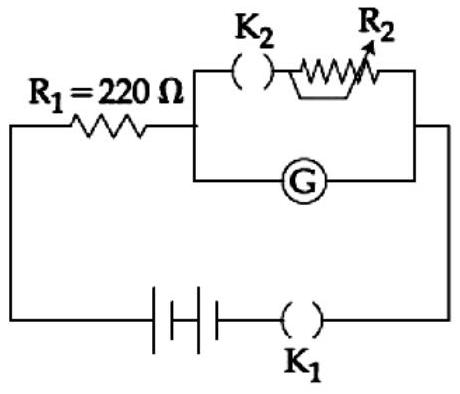
The galvanometer deflection, when key K1 is closed but K2 is open, equals θ0 (see figure). On closing K2 also and adjusting R2 to 5Ω, the deflection in galvanometer becomes 5θ0. The resistance of the galvanometer is, then, given by [Neglect the internal resistance of battery]:
(A)5Ω
(B)22Ω✓ Correct
(C)25Ω
(D)12Ω
Answer: (B)
Solution
With K1 closed and K2 open the galvanometer carries the full current i1=220+GE, where 220Ω is the fixed series resistance and G the galvanometer resistance; this produces the deflection θ0. Closing K2 puts the 5Ω resistor in parallel with the galvanometer, so the current splits and only the fraction G+55 of the line current reaches the coil. Working out the galvanometer current in this second state and demanding that it be one-fifth of i1, since the deflection drops to 5θ0, gives 220(G+5)+5G5(220+G)=51. Cross-multiplying, 25(220+G)=225G+1100, which simplifies to 4400=200G, so G=22Ω.
JEE Main · 2019 · 12 Jan 2019 · Shift 1 · Single correct option