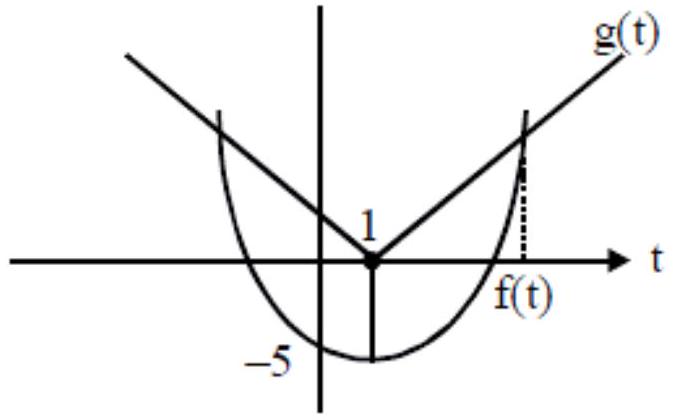
Put t=2x>0, turning the equation into 5+∣t−1∣=t2−2t. For t≥1 it reads t2−3t−4=0, i.e. (t−4)(t+1)=0, giving the admissible t=4. For 0<t<1 it reads t2−t−6=0, i.e. (t−3)(t+2)=0, whose roots 3 and −2 are both outside (0,1). Only t=4 survives, and since t=2x is one-to-one it yields a single real x; the equation has one real root.
JEE Main · 2019 · 10 Apr 2019 · Shift 2 · Single correct option