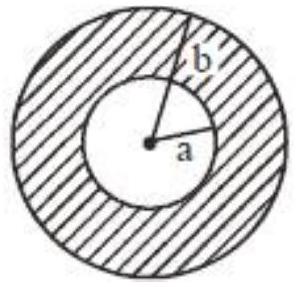
A circular disc of radius b has a hole of radius a at its centre (see figure). If the mass per unit area of the disc varies as (rσ0), then the radius of gyration of the disc about its axis passing through the centre is :
(A)3a+b
(B)3a2+b2+ab✓ Correct
(C)2a+b
(D)2a2+b2+ab
Answer: (B)
Solution
Take a thin ring of radius r and thickness dr. Its mass is dm=σ⋅2πrdr=rσ0⋅2πrdr=2πσ0dr, and it contributes dI=r2dm=2πσ0r2dr to the moment of inertia. Integrating from a to b, the moment of inertia is I=32πσ0(b3−a3) and the total mass is m=∫ab2πσ0dr=2πσ0(b−a). The radius of gyration is then k=mI=3(b−a)b3−a3=3a2+b2+ab, using b3−a3=(b−a)(a2+ab+b2).
JEE Main · 2019 · 12 Apr 2019 · Shift 1 · Single correct option