JEE Main · 2019 · 10 Jan 2019 · Shift 1 · Atomic Structure

WhatsApp Email
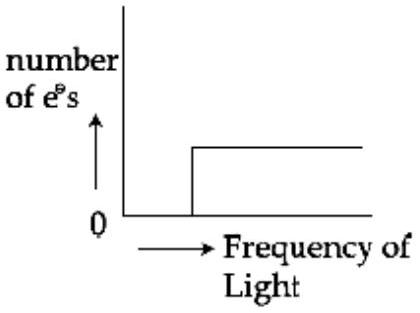
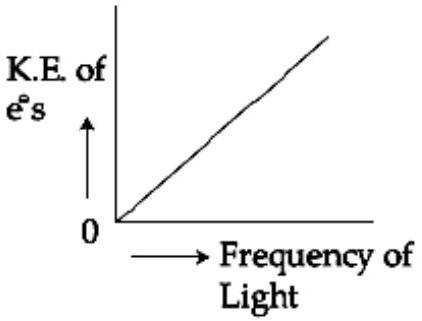
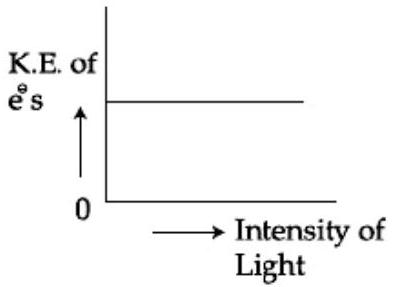
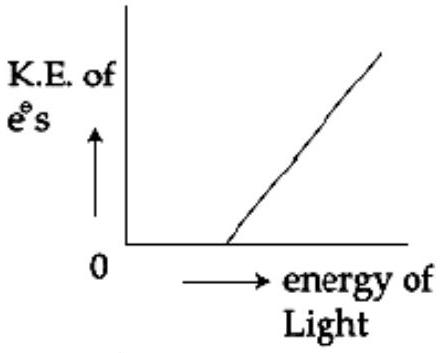
Which of the graphs shown below does not represent the relationship between incident light and the electron ejected from metal surface?
  1. (A)(see graph)
  2. (B)(see graph)
    ✓ Correct
  3. (C)(see graph)
  4. (D)(see graph)

Answer: (B)

Solution

Einstein's photoelectric relation is a straight line of kinetic energy against frequency, with positive slope and an intercept fixed by the threshold frequency, and it carries no feature that would bend or invert that line. The graph showing a relationship the equation forbids, where the ejected-electron quantity varies with the incident light in a way the linear law does not allow, is the one that fails to represent the effect.

JEE Main · 2019 · 10 Jan 2019 · Shift 1 · Single correct option
More JEE Main questions on Atomic Structure

  1. Given below are two statements:

    Statement I: When an electric discharge is passed through gaseous hydrogen, the hydrogen molecules dissociate and the energetically excited hydrogen atoms produce electromagnetic radiation of discrete frequencies.

    Statement II: The frequency of s …
    JEE Main 2026View solution →
  2. The energy required by electrons, present in the first Bohr orbit of hydrogen atom to be excited to second Bohr orbit is ____ .

    Given : .
    JEE Main 2026View solution →
  3. Consider the following spectral lines for atomic hydrogen:
    A. First line of Paschen series
    B. Second line of Balmer series
    C. Third line of Paschen series
    D. Fourth line of Bracket series

    The correct arrangement of the above lines in ascending order of energy is:
    JEE Main 2026View solution →
  4. The energy of first (lowest) Balmer line of H atom is x J. The energy (in J) of second Balmer line of H atom is :
    JEE Main 2026View solution →
  5. Which of the following statements regarding the energy of the stationary state is true in the following one-electron system ?
    JEE Main 2026View solution →
  6. Given,
    (A)
    (B)

    The maximum number of electron(s) in an atom that can have the quantum numbers as given in (A) and (B) respectively are :
    JEE Main 2026View solution →