JEE Main · 2020 · 04 Sep 2020 · Shift 1 · Chemical Kinetics

WhatsApp Email
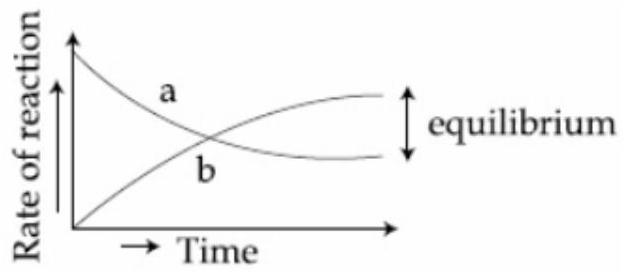
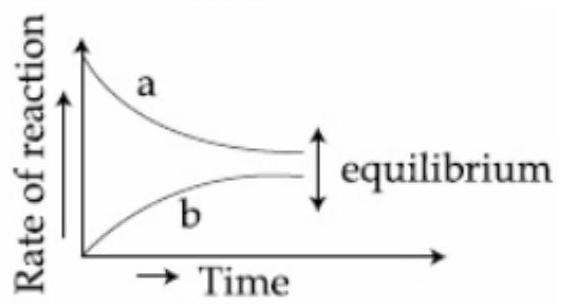
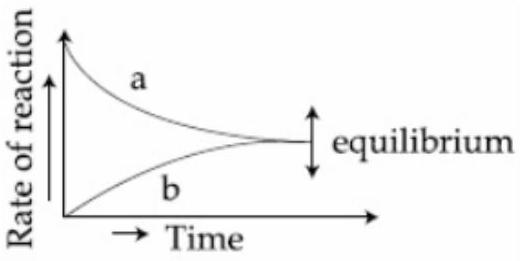
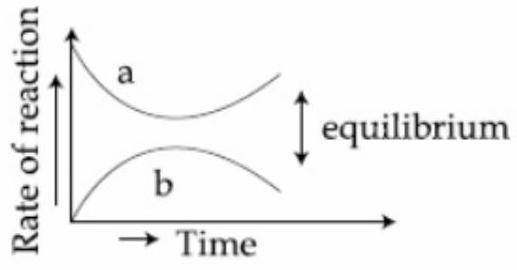
For the equilibrium , the variation of the rate of the forward (a) and reverse (B) reaction with time is given by:
  1. (A)(see structure)
  2. (B)(see structure)
  3. (C)(see structure)
  4. (D)(see structure)
    ✓ Correct

Answer: (D)

Solution

Starting from pure A, the forward rate is largest at the beginning when is high and is zero, and it falls as A is consumed, while the reverse rate starts at zero and climbs as builds up. The two rates approach each other and, at equilibrium, become equal and then stay constant. The graph in which the forward rate decreases from a high value and the reverse rate rises from zero until they meet and level off together represents this behaviour.

JEE Main · 2020 · 04 Sep 2020 · Shift 1 · Single correct option
More JEE Main questions on Chemical Kinetics

  1. Pre-exponential factors of two different reactions of same order are identical. Let activation energy of first reaction exceeds the activation energy of second reaction by . If and are the rate constants of fir …
    JEE Main 2026View solution →
  2. A → products (First order reaction).

    Three sets of experiment were performed for a reaction under similar experimental conditions.
    Run of 10 M solution of reactant A
    Run of 10 M solution of reactant A
    Run …
    JEE Main 2026View solution →
  3. The temperature at which the rate constants of the given below two gaseous reactions become equal is
    ____ K. (Nearest integer).
    …
    JEE Main 2026View solution →
  4. Decomposition of A is a first order reaction at and is given by . In a closed 1 L vessel, 1 bar is allowed to decompose at . …
    JEE Main 2026View solution →
  5. Correct statements regarding Arrhenius equation among the following are :
    (A) Factor corresponds to fraction of molecules having kinetic energy less than Ea.
    (B) At a given temperature, lower the Ea, faster is the reaction.
    (C) Increase in tempe …
    JEE Main 2026View solution →
  6. Consider and are two reactions. If the rate constant of the reaction can be expressed by the following equation …
    JEE Main 2026View solution →