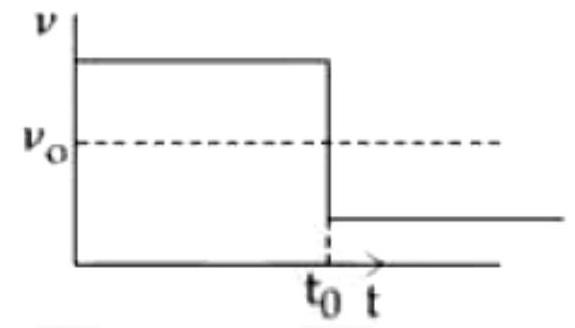
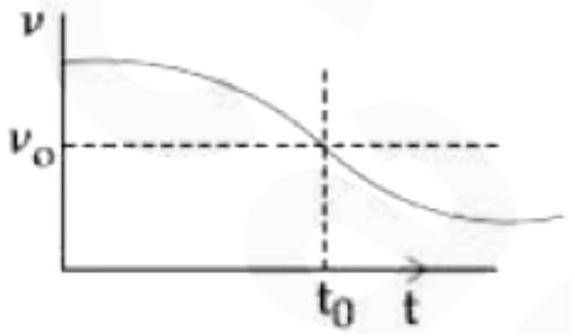
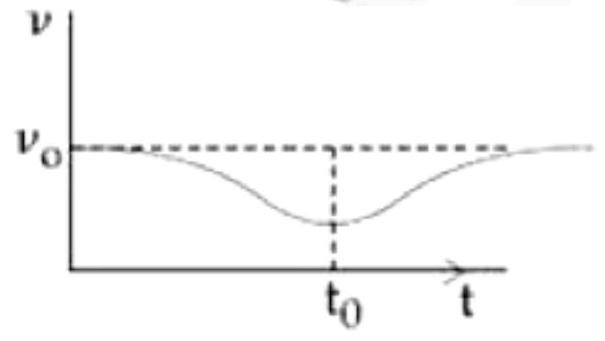
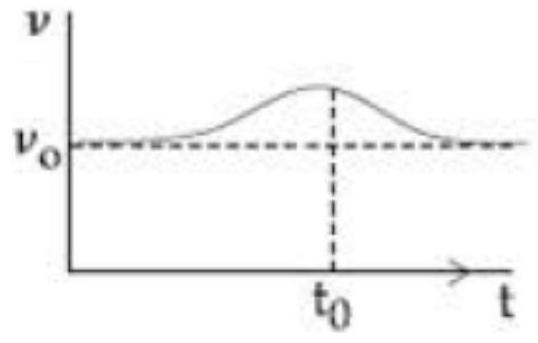
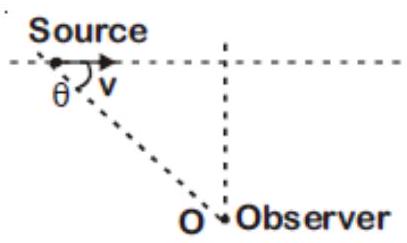
A sound source S is moving along a straight track with speed v, and is emitting sound of frequency v0 (see figure). An observer is standing at a finite distance, at the point O, from the track. The time variation of frequency heard by the observer is best represented by: (t0 represents the instant when the distance between the source and observer is minimum)
(A)(see graph)
(B)(see graph)✓ Correct
(C)(see graph)
(D)(see graph)
Answer: (B)
Solution
As the source moves along the straight track, the frequency the observer hears depends on the component of the source's velocity along the line joining source to observer. While the source approaches, that component points towards the observer, so the heard frequency stays above v0; it is largest when the source is far down the track and falls steadily as the source nears the point of closest approach. At the instant t0 of closest approach the velocity is momentarily perpendicular to the line of sight, the component along it is zero, and the heard frequency equals the true frequency v0. Once the source passes this point it recedes, the velocity component reverses, and the heard frequency drops below v0 and keeps falling. Because the line-of-sight component passes continuously through zero, the curve crosses v0 smoothly at t0 with no sudden jump, giving a single falling curve that begins above v0 and ends below it.
JEE Main · 2020 · 06 Sep 2020 · Shift 1 · Single correct option