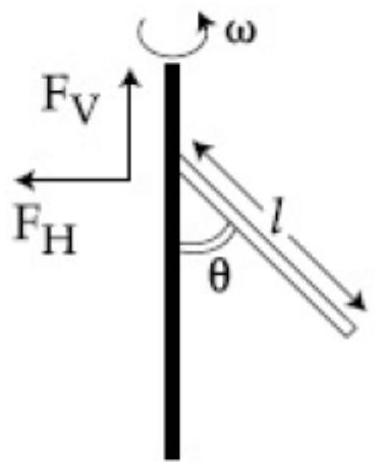
A uniform rod of length 'l' is pivoted at one of its ends on a vertical shaft of negligible radius. When the shaft rotates at angular speed ω the rod makes an angle θ with it (see figure). To find θ equate the rate of change of angular momentum (direction going into the paper) 12ml2ω2sinθcosθ about the centre of mass (CM) to the torque provided by the horizontal and vertical forces FH and FV about the CM. The value of θ is then such that:
(A)cosθ=lω2g
(B)cosθ=3lω22g
(C)cosθ=2lω23g✓ Correct
(D)cosθ=2lω2g
Answer: (C)
Solution
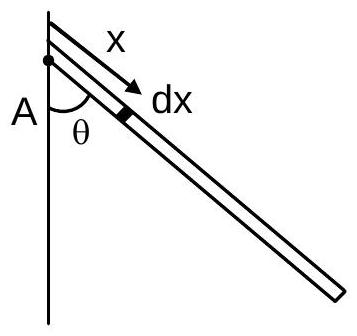
For an element of the spinning rod at distance x from the pivot, the outward inertial effect is ℓmdxω2xsinθ, and its torque about the pivot is this times the lever arm xcosθ. Integrating along the rod, τcf=∫0ℓℓmω2x2sinθcosθdx=3mω2ℓ2sinθcosθ. Gravity acting at the centre of mass supplies the balancing torque mg2ℓsinθ. Setting them equal, mg2ℓsinθ=3mω2ℓ2sinθcosθ, the sinθ cancels and cosθ=2ℓω23g.
JEE Main · 2020 · 03 Sep 2020 · Shift 2 · Single correct option