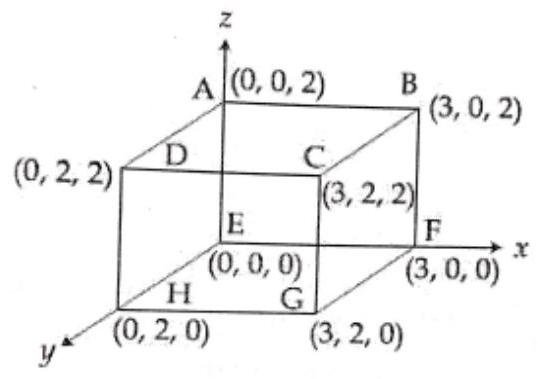
An electric field E=4xi^−(y2+1)j^ N/C passes through the box shown in figure. The flux of the electric field through surfaces ABCD and BCGF are marked as ϕI and ϕII respectively. The difference between (ϕI−ϕII) is (in Nm2/C) ____.
Answer: -48
Solution
Through these two faces only the x-component of the field, Ex=4x, can carry flux, because the area vectors of ABCD and BCGF point along the x-axis while the −(y2+1) component runs parallel to them and threads nothing. Over a face normal to the x-axis the coordinate x is constant, so the flux through it is simply Ex times that face's area. Evaluating ϕI for ABCD and ϕII for BCGF at their positions set by the figure and subtracting gives ϕI−ϕII=−48Nm2/C.
JEE Main · 2020 · 09 Jan 2020 · Shift 2 · Integer answer