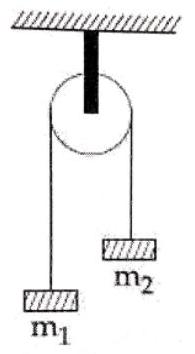
A uniformly thick wheel with moment of inertia I and radius R is free to rotate about its centre of mass (see fig). A massless string is wrapped over its rim and two blocks of masses m1 and m2(m1>m2) are attached to the ends of the string. The system is released for rest. The angular speed of the wheel when m1 descents by a distance h is:
(A)[(m1+m2)R2+12(m1+m2)gh]21
(B)[(m1+m2)R2+12(m1−m2)gh]21✓ Correct
(C)[(m1+m2)R2+1(m1−m2)]21gh
(D)[(m1+m2)R2+1(m1+m2)]21gh
Answer: (B)
Solution
Let the wheel turn with angular speed ω once m1 has descended a height h; since the string does not slip, each block moves with speed v=ωR and m2 rises by the same h. Energy is conserved, so the net loss of gravitational potential energy equals the total kinetic energy gained: (m1−m2)gh=21(m1+m2)v2+21Iω2. Substituting v=ωR gives (m1−m2)gh=21[(m1+m2)R2+I]ω2, so ω=(m1+m2)R2+I2(m1−m2)gh.
JEE Main · 2020 · 09 Jan 2020 · Shift 2 · Single correct option