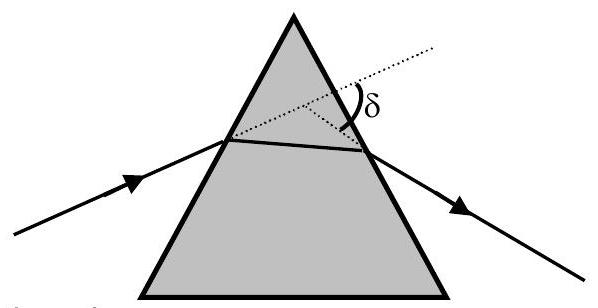
The angle of deviation through a prism is minimum when (A) Incident ray and emergent ray are symmetric to the prism (B) The refracted ray inside the prism becomes parallel to its base (C) Angle if incidence is equal to that of the angle of emergence (D) When angle of emergence is double the angle of incidence
Choose the correct answer from the options given below :
(A)Statements (B) and (C) are true
(B)Statements (A), (B) and (C) are true✓ Correct
(C)Only statement (D) is true
(D)Only statements (A) and (B) are true
Answer: (B)
Solution
The deviation produced by a prism is δ=i+e−A, and for any deviation above the least value there are two distinct paths through the prism, one with angles (i,e) and its reverse (e,i). These two paths merge only when i=e, so the minimum occurs on the symmetric path. With i=e the two refraction angles inside the prism are equal as well, which places the internal ray parallel to the base, and the incident and emergent rays then lie symmetrically about the prism. An emergent angle twice the incident angle breaks that symmetry, so it cannot describe minimum deviation. So the symmetry of the incident and emergent rays about the prism, the refracted ray running parallel to the base, and the equality of the angles of incidence and emergence all hold at minimum deviation, while the doubled emergent angle does not.
JEE Main · 2021 · 16 Mar 2021 · Shift 1 · Single correct option