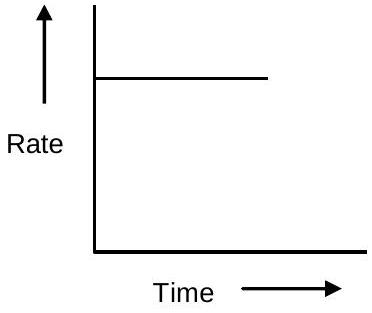
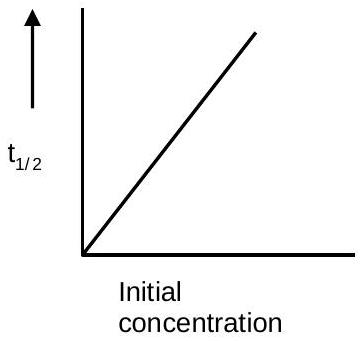
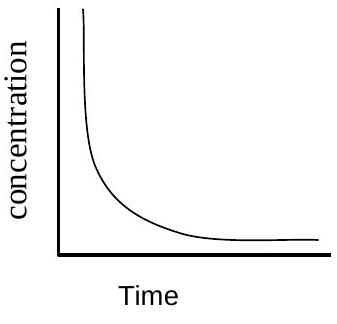
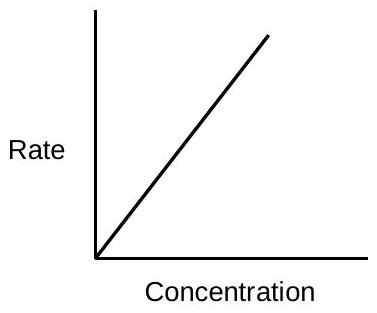
(C)(a) and (b) zero order (c) and (e) First order✓ Correct
(D)(b) zero order (c) and (e) First order
Answer: (C)
Solution
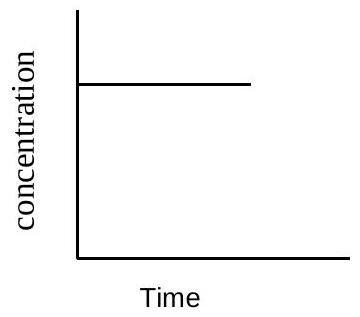
A zero order reaction has a rate that does not depend on concentration, so its rate stays constant as the reaction proceeds and its half life t1/2=2k[A]0 grows in direct proportion to the initial concentration. A first order reaction has rate =k[A], so a plot of rate against concentration is a straight line through the origin, and the concentration itself falls off exponentially with time. Among the five plots, the horizontal rate against time line and the straight half life against initial concentration line through the origin carry the zero order signature, while the exponentially decaying concentration against time curve and the straight rate against concentration line carry the first order signature. The remaining plot, a horizontal concentration against time line, describes a mixture whose composition never changes, so it is no reaction at all; a zero order reaction would show concentration falling linearly. The first two plots are zero order and the third and fifth are first order.
JEE Main · 2021 · 25 Jul 2021 · Shift 1 · Single correct option