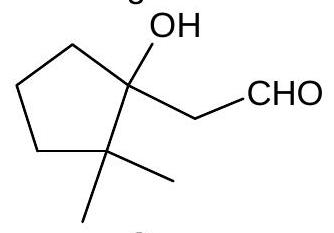
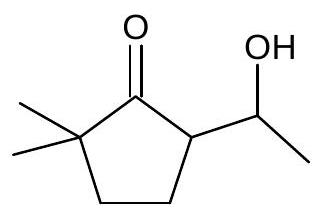
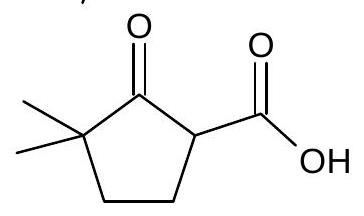
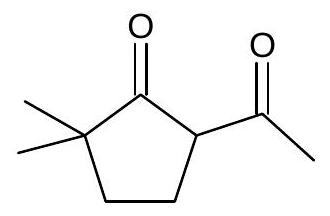
In 2,2-dimethylcyclopentan-1-one one of the two carbons flanking the carbonyl is quaternary, so hydroxide can only remove a hydrogen from the other one. That enolate adds to ethanal, and the crossed aldol product P is 2-(1-hydroxyethyl)-5,5-dimethylcyclopentan-1-one. Iodine in sodium hydroxide then acts on the CH3CH(OH)− group: it is first oxidised to the methyl ketone and the methyl group is then exhaustively iodinated and cleaved, so triiodomethane separates as the yellow solid that is filtered off while the remainder of the molecule stays in the filtrate as a carboxylate. The ring ketone, having no methyl group attached, is untouched. Acidifying the filtrate liberates the free acid, so X is 3,3-dimethyl-2-oxocyclopentane-1-carboxylic acid.
JEE Main · 2021 · 25 Jul 2021 · Shift 1 · Single correct option