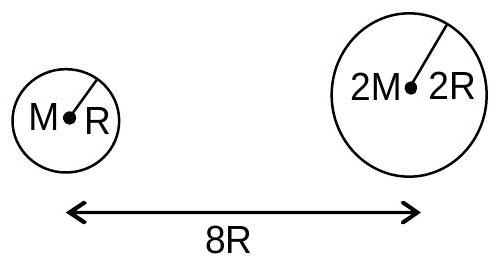
Suppose two planets (spherical in shape) of radii R and 2R, but mass M and 9M respectively have a centre to centre separation 8R as shown in the figure. A satellite of mass 'm' is projected from the surface of the planet of mass 'M' directly towards the centre of the second planet. The minimum speed 'v' required for the satellite to reach the surface of the second plant is 7aRGM then the value of 'a' is ______ [Given: The two planets are fixed in their position]
Answer: 4
Solution
Once past the point where the two pulls cancel, the satellite is drawn in by the heavier planet, so the least speed is the one that brings it to rest exactly there. That point lies at a distance x from the centre of M with x2M=(8R−x)29M, giving 8R−x=3x and x=2R. The potential per unit mass at launch, a distance R from M and 7R from 9M, is
Vi=−RGM−7R9GM=−7R16GM
and at the neutral point, a distance 2R and 6R from the two centres,
Vf=−2RGM−6R9GM=−R2GM
Conservation of energy with zero speed at that point gives
21v2=Vf−Vi=7R2GM⇒v=74RGM
Comparing with the given form, a=4.
Why the neutral point? Between the two planets the net gravitational pull on the satellite is towards M for x<2R and towards 9M for x>2R. So if the satellite just reaches x=2R with zero speed, the 9M planet carries it the rest of the way. Any smaller launch speed means it falls back to M. Hence the minimum-speed condition is "arrives at the neutral point with v=0", not "arrives at the far surface with v=0".