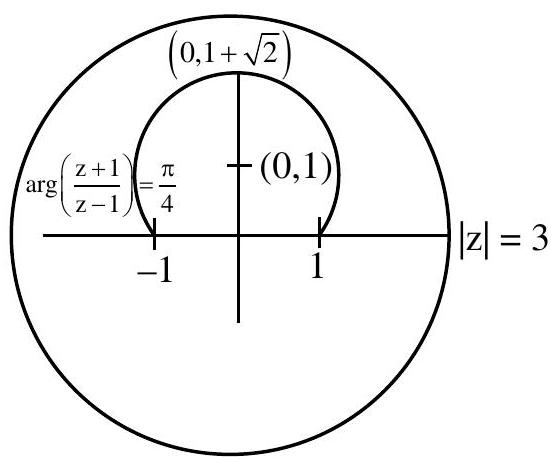
Let arg(z) represent the principal argument of the complex number z. Then, ∣z∣=3 and arg(z−1)−arg(z+1)=4π intersect:
(A)Exactly at one point
(B)Exactly at two points
(C)Nowhere✓ Correct
(D)At infinitely many points
Answer: (C)
Solution
The condition ∣z∣=3 represents a circle of radius 3 centered at the origin. The condition arg(z−1)−arg(z+1)=4π represents the locus of points from which the segment joining −1 and 1 subtends an angle of 4π. This is an arc of a circle passing through −1 and 1. By the inscribed angle theorem, this arc lies on a circle with a specific radius. Computing the radius of this circle and comparing with the circle ∣z∣=3, we find that these two circles do not intersect. Therefore, the two loci have no common points.
JEE Main · 2022 · 29 Jun 2022 · Shift 2 · Single correct option