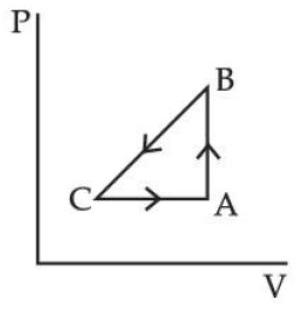
A sample of an ideal gas is taken through the cyclic process ABCA as shown in figure. It absorbs, 40 J of heat during the part AB, no heat during BC and rejects 60 J of heat during CA. A work 50 J is done on the gas during the part BC. The internal energy of the gas at A is 1560 J. The work done by the gas during the part CA is:
(A)20 J
(B)30 J✓ Correct
(C)-30 J
(D)-60 J
Answer: (B)
Solution
Over the full cycle ABCA the internal energy returns to its initial value, so the net heat equals the net work done by the gas. The gas absorbs 40J along AB, exchanges no heat along BC, and rejects 60J along CA, giving net heat 40+0−60=−20J and hence net work −20J. Along BC the 50J done on the gas means the gas does WBC=−50J, and the part AB is at constant volume, so WAB=0. Writing WAB+WBC+WCA=−20 then gives 0−50+WCA=−20, so the work done by the gas along CA is 30J.
JEE Main · 2022 · 28 Jun 2022 · Shift 2 · Single correct option