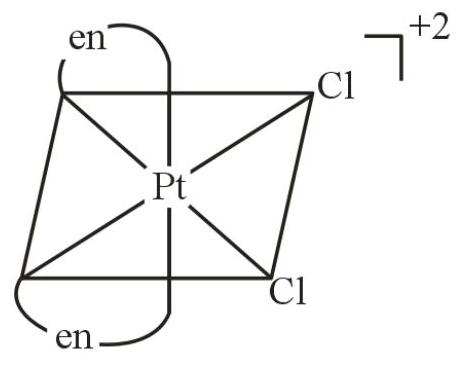
A complex is chiral when it has neither a plane nor a centre of symmetry, so that it and its mirror image cannot be superimposed. The square-planar cis-[PtCl2(NH3)2] and the trans octahedral species each possess a plane of symmetry and are achiral. In cis-[PtCl2(en)2]2+ the two chelating ethylenediamine rings and the two cis chlorides wrap round the metal in a propeller-like arrangement that has no plane or centre of symmetry, so it exists as a pair of non-superimposable enantiomers. The chiral complex is cis-[PtCl2(en)2]2+.
JEE Main · 2023 · 29 Jan 2023 · Shift 1 · Single correct option