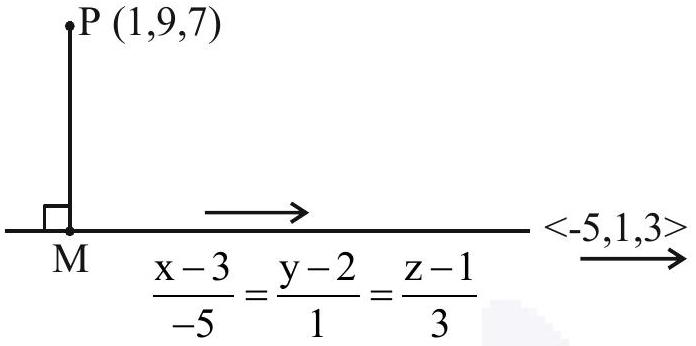
If the foot of the perpendicular drawn from (1,9,7) to the line passing through the point (3,2,1) and parallel to the planes x+2y+z=0 and 3y−z=3 is (α,β,γ), then α+β+γ is equal to
(A)-1
(B)3
(C)1
(D)5✓ Correct
Answer: (D)
Solution
A direction of the line is perpendicular to both plane normals (1,2,1) and (0,3,−1), hence along their cross product (1,2,1)×(0,3,−1)=(−5,1,3). A general point of the line is M=(3−5t,2+t,1+3t). For M to be the foot of the perpendicular from P(1,9,7), the vector PM=(2−5t,t−7,3t−6) must be orthogonal to (−5,1,3): −5(2−5t)+(t−7)+3(3t−6)=35t−35=0, so t=1. Then M=(−2,3,4) and α+β+γ=−2+3+4=5.
JEE Main · 2023 · 24 Jan 2023 · Shift 1 · Single correct option