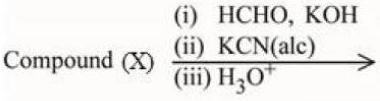
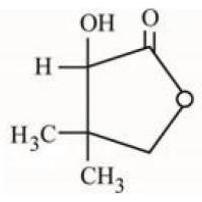
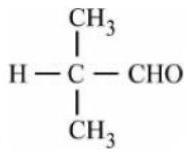
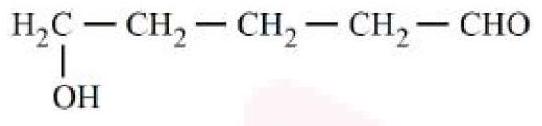
Compound (X) undergoes the following sequence of reactions to give the Lactone (Y): (i) HCHO, KOH (ii) KCN (alc.) (iii) H3O+. The Lactone (Y) is a five-membered gamma-butyrolactone bearing a gem-dimethyl group and an alpha-hydroxy group (alpha-hydroxy-beta,beta-dimethyl-gamma-butyrolactone / pantolactone). Compound (X) is:Lactone (Y)
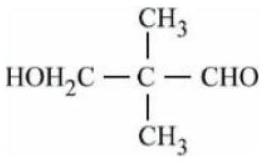
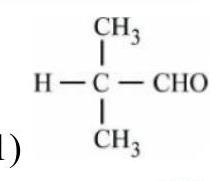
The lactone is a five-membered γ-butyrolactone carrying a gem-dimethyl group and an α-hydroxy group, so the carbon skeleton is built from isobutyraldehyde. Its single α-hydrogen undergoes a crossed aldol with formaldehyde in base to install a −CH2OH group, giving hydroxypivaldehyde HOCH2−C(CH3)2−CHO. Addition of KCN to the aldehyde forms the cyanohydrin, and acidic hydrolysis of the nitrile converts it to the α-hydroxy acid HOCH2−C(CH3)2−CH(OH)−COOH. Intramolecular esterification of the primary −CH2OH with the −COOH then closes the γ-lactone. The required compound X is isobutyraldehyde, (CH3)2CHCHO.
JEE Main · 2023 · 24 Jan 2023 · Shift 1 · Single correct option