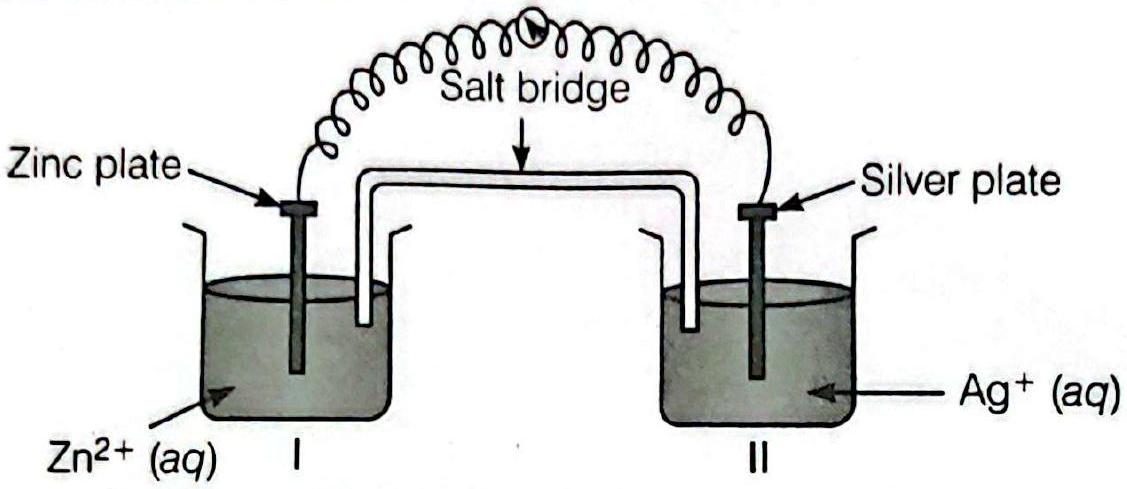
Read the passage given below and answer the questions that follow: Redox reactions involve transfer of electrons from one species to another. In a spontaneous reaction, energy is released and can be used to do useful work. The reaction is split into two half-reactions in two containers, connected by a wire and a salt bridge, forming a voltaic (galvanic) cell — an electrochemical cell that uses a spontaneous redox reaction to generate electricity. The voltmeter reading gives the cell potential (emf). If Ecell∘ is positive the reaction is spontaneous; if negative, non-spontaneous (electrolytic cell). Electrolysis is the decomposition of a substance by an electric current; one mole of electric charge discharges half a mole of a divalent metal ion such as Cu2+ (Faraday's laws). Conductivity (κ) depends on the nature and concentration of the electrolyte and on temperature; molar conductivity is the conductance of the volume of solution containing one mole of electrolyte between electrodes of unit area a unit distance apart. The limiting molar conductivity of weak electrolytes cannot be obtained graphically. [Figure: a Zn–Ag galvanic cell with salt bridge] a) Is the silver plate the anode or the cathode? b) What will happen if the salt bridge is removed? c) When does an electrochemical cell behave like an electrolytic cell? d) (i) What will happen to the concentrations of Zn2+ and Ag+ when E_cell = 0? (ii) Why does the conductivity of a solution decrease with dilution? OR d) The molar conductivity of a 1.5 M solution of an electrolyte is found to be 138.9 S cm2 mol−1. Calculate the conductivity of this solution.Zinc-silver galvanic cell with salt bridge (case-study figure)
Solution
(a) Silver is the cathode — E∘(Ag+/Ag)>E∘(Zn2+/Zn), so reduction (Ag+ + e−→ Ag) occurs on the silver plate. (b) The circuit is broken: positive and negative charge builds up in the two half-cells, the potential difference collapses, and the current stops. (c) When an external opposing potential greater than its own Ecell is applied — the reaction then reverses and the cell works as an electrolytic cell. (d)(i) Ecell=0 means the reaction has reached equilibrium: [Zn2+] (which rose) and [Ag+] (which fell) attain their equilibrium values and no longer change. (ii) Conductivity is the conductance of ions in a unit volume; dilution reduces the number of ions per unit volume, so κ falls. OR (d)