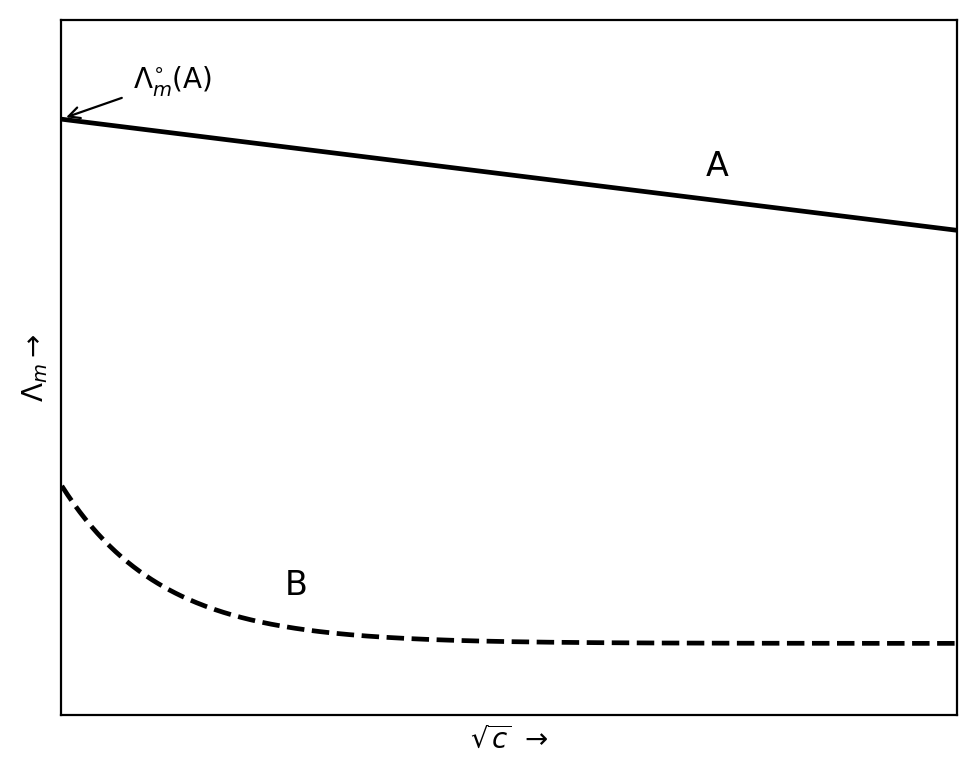
(a) A steady current of 2 amperes was passed through two electrolytic cells X and Y connected in series, containing electrolytes FeSO4 and ZnSO4, until 2.8 g of Fe deposited at the cathode of cell X. How long did the current flow? Calculate the mass of Zn deposited at the cathode of cell Y. (Molar mass: Fe = 56 g mol−1, Zn = 65.3 g mol−1, 1 F = 96500 C mol−1) (b) In the plot of molar conductivity (Λ_m) vs square root of concentration (c1/2), the following curves are obtained for two electrolytes A and B (see figure). Answer the following: (i) Predict the nature of electrolytes A and B. (ii) What happens on extrapolation of Λ_m to concentration approaching zero for electrolytes A and B?Molar conductivity vs square root of concentration for electrolytes A and B
Solution
(a) Moles of Fe:
n=562.8=0.05mol
Fe2+ + 2e−→ Fe, so charge:
Q=0.05×2×96500=9650C
Time:
t=29650
t=4825s≈80.4min
Series cells pass the same charge; Zn2+ + 2e−→ Zn also needs 2 electrons, so moles of Zn = 0.05:
mZn=0.05×65.3
mZn=3.27g
(b)(i) A, varying linearly with a gentle slope, is a strong electrolyte; B, shooting up steeply as c→0, is a weak electrolyte. (ii) For A, extrapolating the straight line to c1/2=0 gives the limiting molar conductivity Λm∘. For B the curve rises too steeply for extrapolation — its Λm∘ must be obtained from Kohlrausch's law of independent migration of ions.