CBSE Class 12 · 2002 · Delhi · SolutionsShort Answer

WhatsApp Email
Draw a suitable diagram to express the relationship for ideal solutions of A and B between vapour pressures and mole fractions of components at constant temperature.

Solution

For an ideal solution, each partial pressure follows Raoult's law:

On a graph of pressure against mole fraction ( from 0 to 1), and are straight lines from the origin-ends to and respectively, and the total pressure

is the straight line joining (at ) to (at ), lying above both partial-pressure lines (see figure).
Structure Ideal solution: partial pressures and total pressure vs mole fraction (Raoult's law)
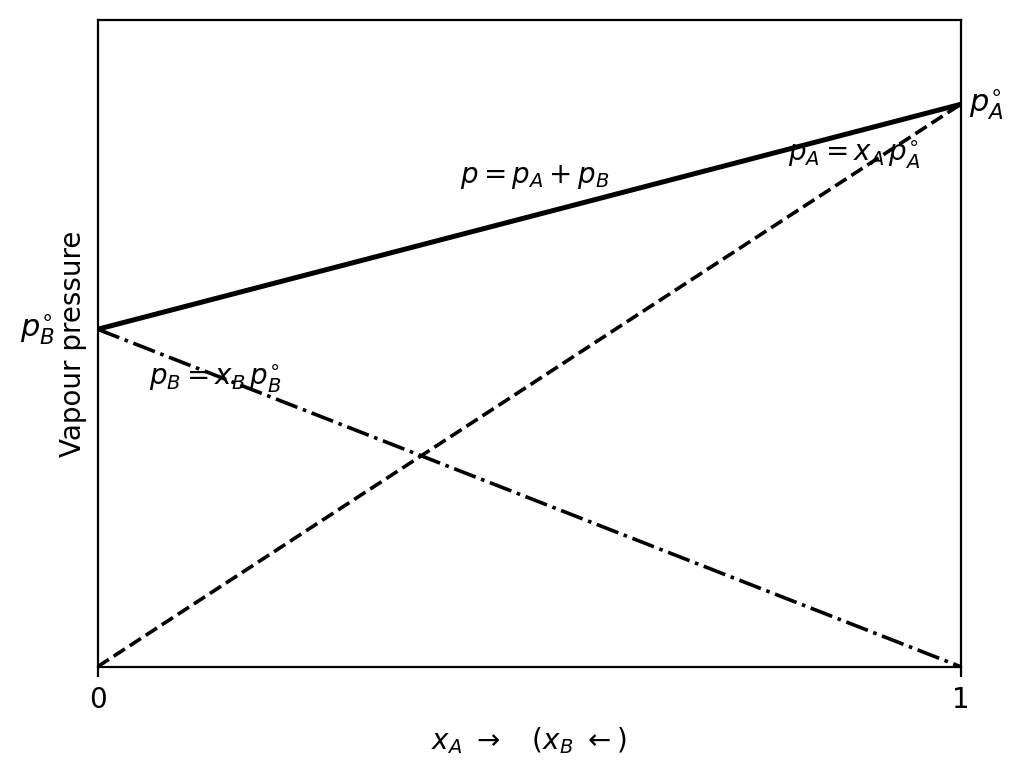
Ideal solution: partial pressures and total pressure vs mole fraction (Raoult's law)

CBSE Class 12 Board · 2002 · Delhi · Subjective

More board questions on Solutions

  1. Isotonic solutions have the same
    CBSE 2024View solution →
  2. Van't Hoff factor for NaSO10HO solution, assuming complete ionization, is
    CBSE 2024View solution →
  3. (a)(i) Ishan's automobile radiator is filled with 1.0 kg of water. How many grams of ethylene glycol (molar mass = 62 g mol) must Ishan add to get the freezing point of the solution lowered to −2.8°C? (K for water = 1.86 K kg mol)
    (ii) What type of deviation fro …
    CBSE 2024View solution →
  4. (b)(i) The boiling point of water at 750 mm Hg pressure is 99.68°C. How much sucrose (molar mass = 342 g mol) is to be added to 500 g of water so that it boils at 100°C? (K for water = 0.52 K kg mol)
    (ii) State Henry's law and write any one application of it.
    CBSE 2024View solution →
  5. Which of the following aqueous solutions will have the highest boiling point?
    CBSE 2023View solution →
  6. (i) Why is the boiling point of 1 M NaCl solution more than that of 1 M glucose solution?
    (ii) A non-volatile solute 'X' (molar mass = 50 g mol), when dissolved in 78 g of benzene, reduced its vapour pressure to 90%. Calculate the mass of X dissolved in the solution.
    (iii) …
    CBSE 2023View solution →