CBSE Class 12 · 2012 · Linear ProgrammingLong Answer

WhatsApp Email
A manufacturer produces nuts and bolts. It takes 1 hour of work on machine A and 3 hours on machine B to produce a package of nuts. It takes 3 hours on machine A and 1 hour on machine B to produce a package of bolts. He earns a profit of Rs. 17.50 per package on nuts and Rs. 7 per package on bolts. How many packages of each should be produced each day so as to maximize his profit, if he operates his machines for at most 12 hours a day? Formulate the above as a linear programming problem and solve it graphically.

Answer: Max profit = Rs 73.50 at (3, 3): 3 packages of nuts and 3 packages of bolts

Solution

Let packages of nuts and packages of bolts be produced per day.
Profit: .
Machine A:
Machine B:

Corner points: , , (intersection of and ) and .
Evaluate :
:
: ← maximum
:

3 packages of nuts and 3 packages of bolts should be produced each day.
Structure Feasible region for x + 3y = 12 and 3x + y = 12, with corner points (0, 0), (4, 0), (3, 3) and (0, 4).
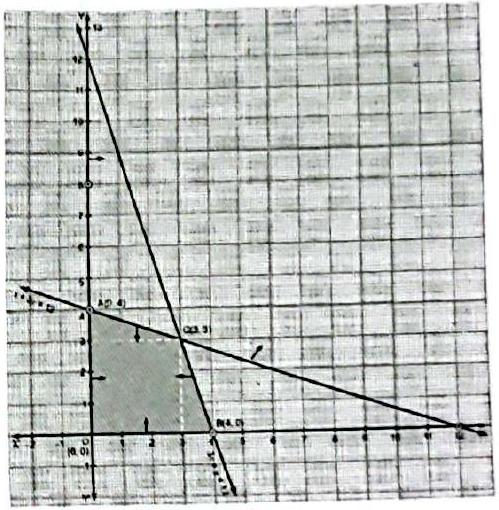
Feasible region for x + 3y = 12 and 3x + y = 12, with corner points (0, 0), (4, 0), (3, 3) and (0, 4).

CBSE Class 12 Board · 2012 · Subjective

More board questions on Linear Programming

  1. Solve the following Linear Programming problem graphically:
    Maximize
    subject to


    CBSE 2024View solution →
  2. The objective function of an LPP has maximum value 42 at and minimum value 19 at . Which of the following is true?
    CBSE 2023View solution →
  3. The corner points of the feasible region of a linear programming problem are , and . If is the objective function, then (maximum value of minimum value of ) is equal to:
    CBSE 2023View solution →
  4. Solve the following linear programming problem graphically:
    Maximize
    subject to the constraints


    CBSE 2023View solution →
  5. The corner points of the feasible region determined by the system of linear inequalities are , , and . If the maximum value of , where , occurs at both and , then:
    CBSE 2020View solution →
  6. A furniture trader deals in only two items — chairs and tables. He has Rs. 50,000 to invest and a space to store at most 35 items. A chair costs him Rs. 1000 and a table costs him Rs. 2000. The trader earns a profit of Rs. 150 and Rs. 250 on a chair and a table, respectively. For …
    CBSE 2020View solution →