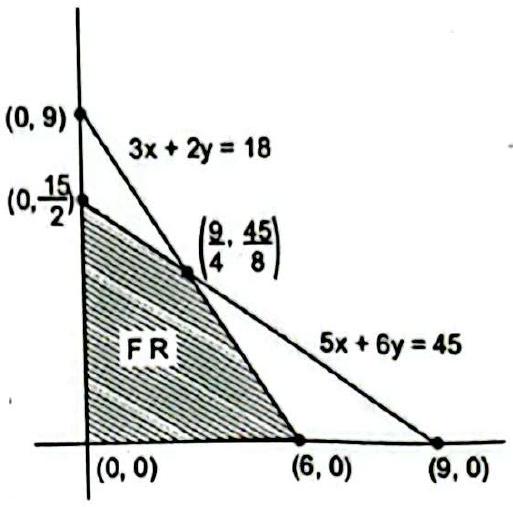
A factory owner purchases two types of machines, A and B, for his factory. The requirements and the limitations for the machines are as follows: Machine A: occupies 1000m2, needs 12 men, daily output 60 units. Machine B: occupies 1200m2, needs 8 men, daily output 40 units. He has a maximum area of 9000m2 available, and 72 skilled labourers who can operate both the machines. How many machines of each type should he buy to maximize the daily output?
Answer: Max output = 360 units at (6, 0): 6 machines of type A and none of type B
Solution
Let the owner buy x machines of type A and y of type B. Daily output to maximise: Z=60x+40y. Area: 1000x+1200y≤9000⟹5x+6y≤45 Labour: 12x+8y≤72⟹3x+2y≤18 x≥0,y≥0 Corner points: (0,0), (6,0), (49,845) (intersection of the two lines) and (0,215). Evaluate Z=60x+40y: (0,0): Z=0 (6,0): Z=360 ← maximum (49,845): Z=135+225=360 ← also maximum (0,215): Z=300 The maximum Z=360 occurs at (6,0) and at (49,845). Since the number of machines must be a whole number, only (6,0) is admissible.
∴Zmax=360 at (6,0)
The owner should buy 6 machines of type A (and none of type B).Feasible region for 5x + 6y = 45 and 3x + 2y = 18, with corner points (0, 0), (6, 0), (9/4, 45/8) and (0, 15/2).