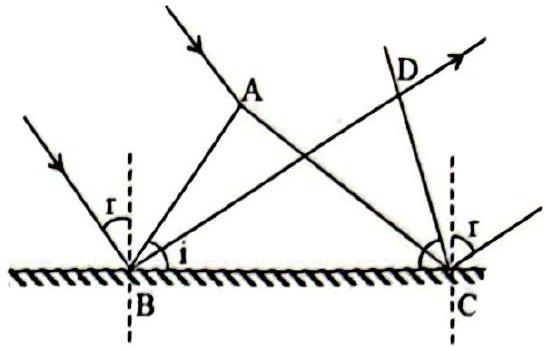
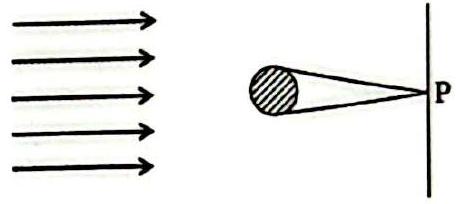
(a) Define a wavefront. Using Huygens' principle, verify the laws of reflection at a plane surface. (b) In a single slit diffraction experiment, the width of the slit is made double the original width. How does this affect the size and intensity of the central diffraction band? Explain. (c) When a tiny circular obstacle is placed in the path of light from a distant source, a bright spot is seen at the centre of the obstacle. Explain why.
Solution
(a) Wavefront: the locus of all points oscillating in the same phase. For reflection, let a plane wavefront AB strike a plane surface at angle i; while the wavelet from A travels AD, the point B travels BC=AD to the surface. Triangles ABC and ADC are congruent (common AC, BC=AD, right angles), so ∠BAC=∠DCA, i.e.
i=r
(b) The angular half-width of the central band is θ=aλ, so its linear width a2λD∝a1. Doubling ahalves the width of the central band; because the amplitude admitted doubles while the width halves, the central intensity becomes about four times as great. (c) Light diffracts around the edge of the small circular obstacle. By symmetry all the rim's diffracted wavelets travel equal distances to the centre of the geometric shadow, arriving in phase and interfering constructively, producing a bright spot (the Poisson/Arago spot) at the centre.