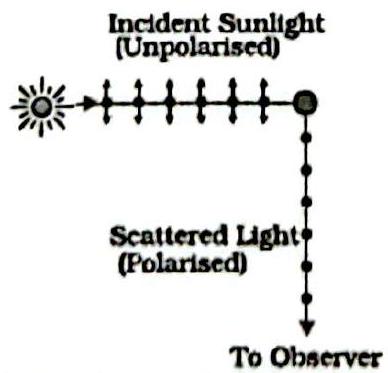
Explain with a diagram how plane polarized light can be produced by scattering of sunlight. An incident beam of light of intensity I0 is made to fall on a polaroid A. Another polaroid B is so oriented with respect to A that there is no light emerging out of B. A third polaroid C is now introduced mid-way between A and B and is so oriented that its axis bisects the angle between the axes of A and B. Calculate the intensity of light transmitted by A, B and C.
Answer:IA=2I0, IC=4I0, IB=8I0.
Solution
Polarization by scattering: unpolarised sunlight falling on air molecules sets their electrons oscillating. For light scattered at 90∘, only the vibrations perpendicular to the plane containing the incident ray and the line of sight radiate towards the observer, so the scattered light is plane polarized. Calculation: A and B are crossed (90∘ apart), and C bisects the angle, so C makes 45∘ with both A and B. After A (unpolarised I0): IA=2I0. Through C (45∘ to A): IC=2I0cos245∘=2I0⋅21=4I0. Through B (45∘ to C): IB=4I0cos245∘=4I0⋅21=8I0.
IA=2I0,IC=4I0,IB=8I0
(Without C, B transmits zero; introducing C restores some light through the crossed pair.)