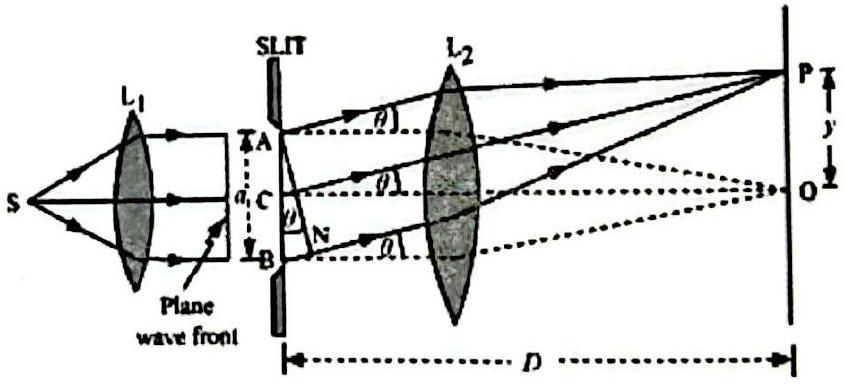
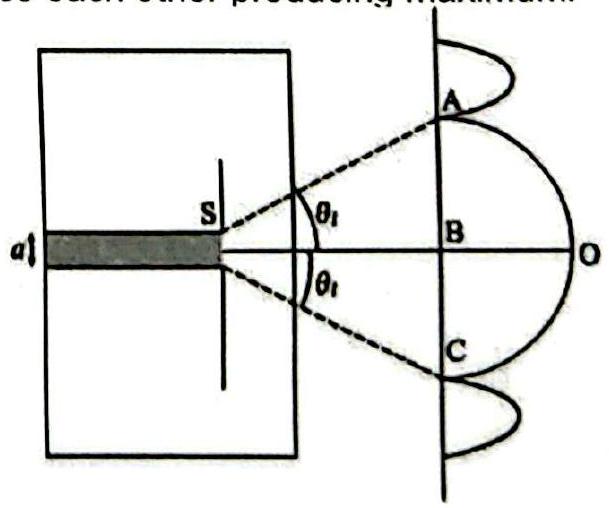
(a) Using Huygens' construction of secondary wavelets explain how a diffraction pattern is obtained on a screen due to a narrow slit on which a monochromatic beam of light is incident normally. (b) Show that the angular width of the first diffraction fringe is half that of the central fringe. (c) Explain why the maxima at θ=(n+21)aλ become weaker and weaker with increasing n.
Solution
(a) By Huygens' construction, every point of the wavefront at the slit AB (width a) is a source of secondary wavelets. Wavelets along the axis arrive in phase, giving the bright central maximum at O; in other directions the path difference asinθ causes the wavelets to interfere, producing alternate dark and bright bands of decreasing intensity. (b) The central maximum lies between the first minima at θ=±aλ, so its angular width is
2θ1=a2λ
The first secondary (bright) fringe lies between the first and second minima, i.e. between θ=aλ and θ=a2λ, so its angular width is
a2λ−aλ=aλ=21(a2λ)
angular width of first fringe=21×central width
(c) At the n-th secondary maximum the slit divides into (2n+1) equal strips; 2n of them cancel in pairs and only one strip, a fraction 2n+11 of the slit, contributes. As n increases this fraction shrinks, so the maxima become progressively weaker.