CBSE Class 12 · 2004 · Wave OpticsVery Short Answer

WhatsApp Email
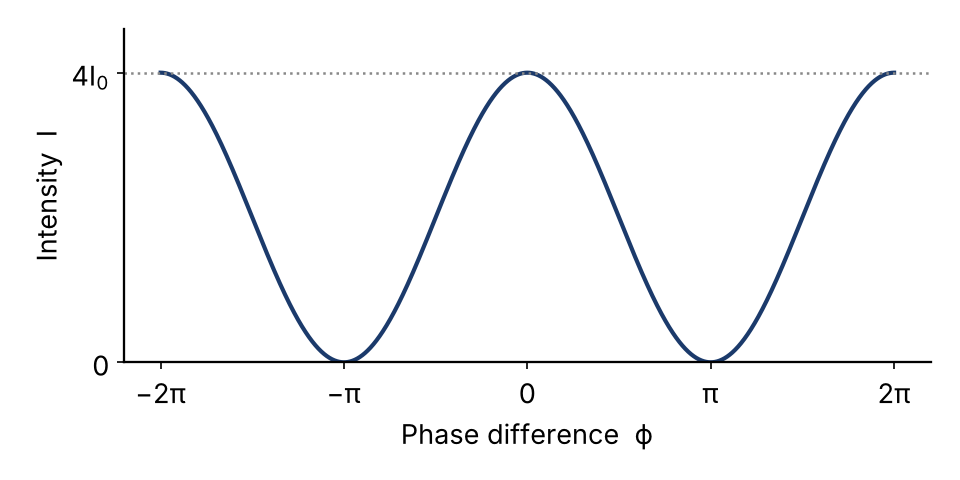
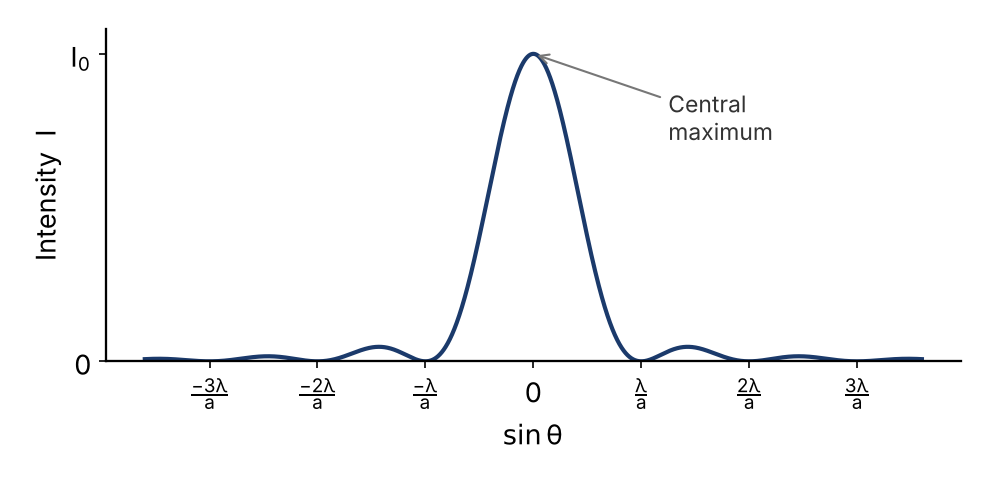
Two narrow slits are illuminated by a single monochromatic source. Name the pattern obtained on the screen. One of the slits is now completely covered. What is the name of the pattern now obtained on the screen? Draw the intensity pattern obtained in the two cases. Also write two differences between the patterns obtained in the above two cases.

Answer: With both slits open: an interference pattern. With one slit covered: a single-slit diffraction pattern.

Solution

With both narrow slits open and fed by one monochromatic source, the two slits act as coherent sources and an pattern is obtained. When one slit is covered, only one slit remains and a single-slit pattern is obtained.
The two intensity distributions are shown in the figures: interference gives equally spaced fringes of equal brightness, while diffraction gives a broad bright central maximum with weaker side maxima.
Two differences:
(i) Interference fringes are equally spaced and of equal width; diffraction fringes are not equally spaced (the central band is twice as wide).
(ii) In interference all bright fringes have the same intensity and the minima are perfectly dark; in diffraction the intensity of the maxima falls off rapidly and the minima are not perfectly dark.
CBSE Class 12 Board · 2004 · Subjective

More board questions on Wave Optics

  1. In a Young's double slit experiment in air, the fringe width is found to be mm. If the entire setup is immersed in water , the fringe width will be
    CBSE 2024View solution →
  2. Assertion (A): In a Young's double-slit experiment, interference pattern is not observed when two coherent sources are infinitely close to each other.
    Reason (R): The fringe width is proportional to the separation between the two sources.
    CBSE 2024View solution →
  3. A ray of monochromatic light propagating in air is incident on the surface of water. Which of the following will be the same for the reflected and refracted rays?
    CBSE 2023View solution →
  4. Assertion (A): In Young's double slit experiment all fringes are of equal width.
    Reason (R): The fringe width depends upon wavelength of light used, distance of screen from plane of slits and slit separation .
    CBSE 2023View solution →
  5. What happens to the interference pattern when two coherent sources are
    (a) infinitely close, and
    (b) far apart from each other?
    CBSE 2023View solution →
  6. How will the interference pattern in Young's double-slit experiment be affected if:
    (i) the screen is moved away from the plane of the slits;
    (ii) the source slit is moved away from the plane of the slits;
    (iii) the phase difference between the light waves emanating from the two …
    CBSE 2022View solution →