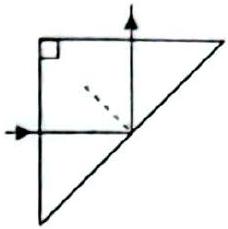
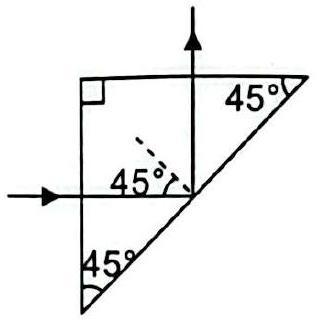
(a) Plot a graph to show the variation of the angle of deviation as a function of the angle of incidence for light passing through a prism. Derive an expression for the refractive index of the prism in terms of the angle of minimum deviation and the angle of the prism. (b) What is dispersion of light? What is its cause? (c) A ray of light incident normally on one face of a right isosceles prism is totally reflected as shown in the figure. What must be the minimum value of the refractive index of the glass? Give relevant calculations.
Solution
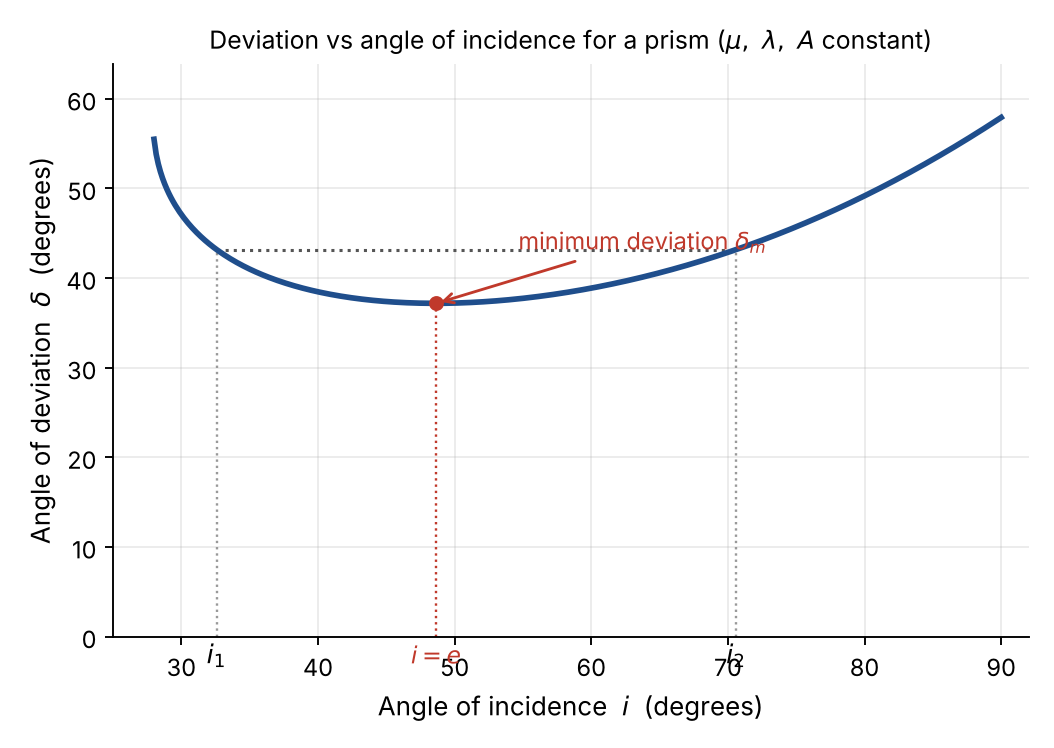
(a) The deviation δ first decreases, reaches a minimum δm (when i=e, r1=r2=A/2), then increases with i. At minimum deviation
μ=sin(2A)sin(2A+δm)
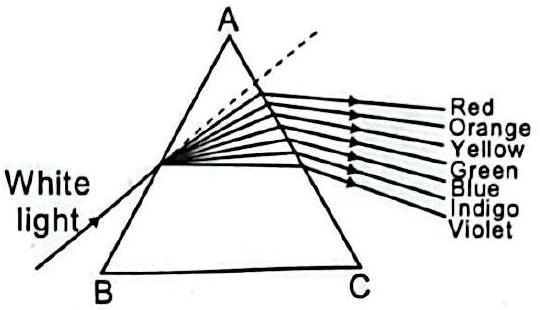
(b) \textbf{Dispersion}: splitting of white light into its constituent colours on passing through a prism. \textbf{Cause}: the refractive index (and hence δ=(μ−1)A) depends on wavelength, so different colours deviate by different amounts. (c) In a right isosceles prism the ray strikes the hypotenuse at 45∘. For TIR, 45∘≥θc, i.e. sin45∘≥μ1⇒μ≥2. Hence μmin=2.