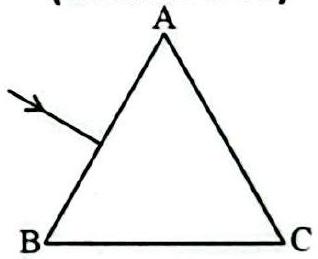
(a) Show, using a proper diagram, how unpolarised light can be linearly polarised by reflection from a transparent glass surface. (b) The figure shows a ray of light falling normally on the face AB of an equilateral glass prism having refractive index 23, placed in water of refractive index 34. Will this ray suffer total internal reflection on striking the face AC? Justify your answer.
Solution
(a) When unpolarised light is incident on glass at the Brewster angle iB (taniB=μ), the reflected and refracted rays are perpendicular, and the \emph{reflected} ray is completely linearly polarised (its vibrations are perpendicular to the plane of incidence). (b) The ray enters normally through AB and strikes AC at 60∘. Relative refractive index μrel=4/33/2=89=1.125.
sinθc=μrel1=98=0.889⇒θc≈62.7∘
Since 60∘<62.7∘, the ray does \emph{not} undergo total internal reflection; it refracts and emerges from AC.