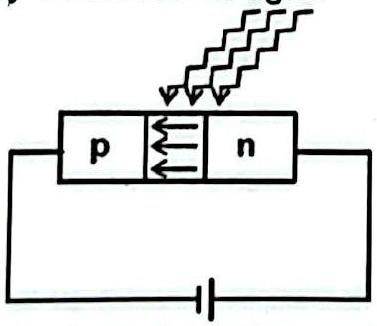
(a) Three photodiodes D1, D2 and D3 are made of semiconductors having band gaps of 2.5 eV, 2 eV and 3 eV respectively. Which of them will not be able to detect light of wavelength 600 nm? (b) Why are photodiodes required to operate in reverse bias? Explain.
Answer:D1 and D3 cannot detect (band gap >2.07 eV); reverse bias gives sensitive detection.
Solution
(a) Energy of a 600 nm photon:
E=600nm1240eVnm≈2.07eV.
A photodiode detects light only if the photon energy exceeds its band gap (E≥Eg). Here E=2.07eV exceeds only Eg=2eV (diode D2); diodes D1 (2.5eV) and D3 (3eV) have larger band gaps and therefore cannot detect the 600 nm light. (b) In reverse bias the depletion region is wide and the field is strong, so the electron–hole pairs generated by the incident photons are swept apart quickly. The fractional change in the (small) reverse current caused by illumination is large, making the device a sensitive and linear detector of light intensity.
D1 and D3 cannot detect; reverse bias gives sensitive detection