CBSE Class 12 · 2023 · Modern PhysicsLong Answer

WhatsApp Email
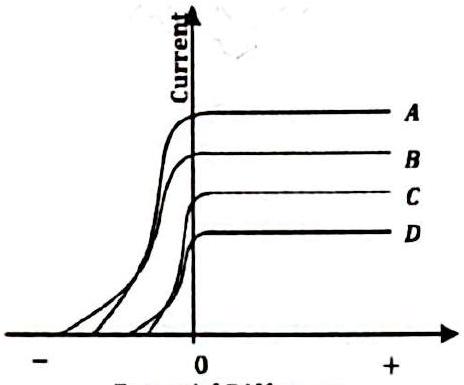
(a) The figure shows the variation of photoelectric current measured in a photo-cell circuit as a function of the potential difference between the plates of the photo-cell when light beams A, B, C and D of different wavelengths are incident on the photo-cell. Examine the figure and answer: (i) Which light beam has the highest frequency and why? (ii) Which light beam has the longest wavelength and why? (iii) Which light beam ejects photoelectrons with maximum momentum and why?

Answer: (i) B (highest frequency),
(ii) C (longest wavelength),
(iii) B (maximum momentum).

Solution

The stopping potential (where each curve meets the potential axis on the retarding side) fixes the maximum kinetic energy, through .
(i) **Highest frequency beam B**: it has the greatest stopping potential, hence the largest and (for the same metal) the highest frequency.
(ii) **Longest wavelength beam C**: it has the smallest stopping potential, hence the lowest frequency and therefore the longest wavelength ().
(iii) **Maximum momentum beam B**: the largest means the largest electron speed, and momentum is greatest for beam B.

CBSE Class 12 Board · 2023 · Subjective

More board questions on Modern Physics

  1. The potential energy between two nucleons inside a nucleus is minimum at a distance of about
    CBSE 2024View solution →
  2. The variation of the stopping potential with the frequency of the incident radiation for four metals A, B, C and D is shown in the figure. For the same frequency of incident radiation producing photo-electrons in all metals, the kinetic energy of photo-electrons will …
    CBSE 2024View solution →
  3. The energy of an electron in the ground state of a hydrogen atom is eV. The kinetic and potential energy of the electron in the first excited state will be
    CBSE 2024View solution →
  4. Assertion (A): An alpha particle is moving towards a gold nucleus. The impact parameter is maximum for the scattering angle of .
    Reason (R): The impact parameter in an alpha particle scattering experiment does not depend upon the atomic number of the target nucleus.
    CBSE 2024View solution →
  5. Calculate the energy released / absorbed (in MeV) in the nuclear reaction . Given , , …
    CBSE 2024View solution →
  6. A proton of energy 1.6 MeV approaches a gold nucleus . Find the distance of its closest approach.
    CBSE 2024View solution →