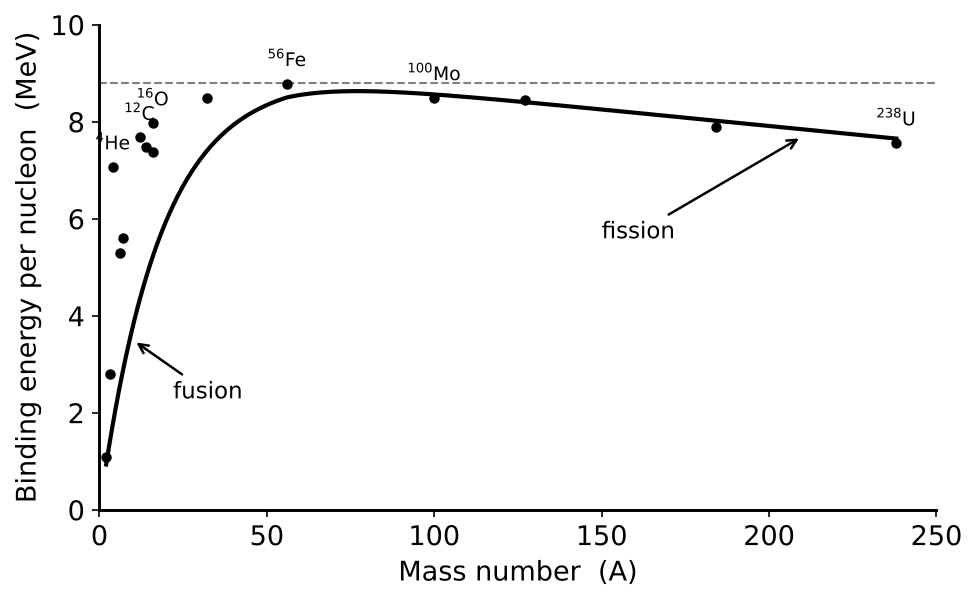
(a) Draw the plot of binding energy per nucleon (BE/A) as a function of mass number A. Write two important conclusions that can be drawn regarding the nature of the nuclear force. (b) Use this graph to explain the release of energy in both the processes of nuclear fusion and fission. (c) Write the basic nuclear process of a neutron undergoing β-decay. Why is the detection of neutrinos found very difficult?
Answer: BE/A peaks near Fe; force short-range & strong; n→p+e−+νˉ; neutrinos weakly interacting.
Solution
(a) The BE/A curve (see figure) rises rapidly for light nuclei, is almost flat and maximum (≈8.8MeV) around A=56, then falls slowly for heavy nuclei. Conclusions: (i) the nearly constant BE/A over 30<A<170 shows the nuclear force is short-range and saturates (a nucleon interacts only with its nearest neighbours); (ii) the high, roughly constant BE/A shows the force is strong and attractive. (b) Both fusion (light nuclei combining) and fission (a heavy nucleus splitting) produce nuclei lying nearer the peak of the curve, i.e. with higher BE/A; the gain in binding energy is released as energy. (c) Basic process: n→p+e−+νˉ. Neutrinos are hard to detect because they are chargeless, nearly massless and interact only through the very weak interaction, passing through matter almost freely.
n→p+e−+νˉ;fusion & fission both move toward the BE/A peak