CBSE Class 12 · 2018 · Modern PhysicsShort Answer

WhatsApp Email
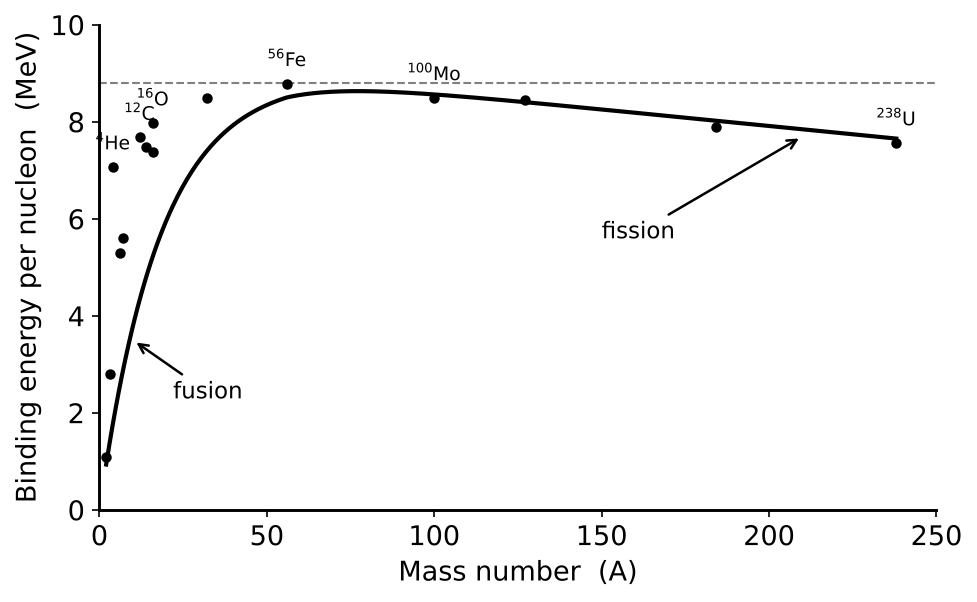
(a) Explain the processes of nuclear fission and nuclear fusion by using the plot of binding energy per nucleon (BE/A) versus the mass number .
(b) A radioactive isotope has a half-life of 10 years. How long will it take for the activity to reduce to 3.12%?

Answer: Both move toward the BE/A peak, releasing energy; years.

Solution

(a) The BE/A curve rises steeply, peaks () near (iron) and then falls slowly for heavy nuclei (see figure).
Fission: a heavy nucleus (low BE/A) splits into middle-mass fragments (higher BE/A); the increase in binding energy is released.
Fusion: very light nuclei (low BE/A) combine into a heavier nucleus of higher BE/A; again energy is released.
(b) , so 5 half-lives:

CBSE Class 12 Board · 2018 · Subjective

More board questions on Modern Physics

  1. The potential energy between two nucleons inside a nucleus is minimum at a distance of about
    CBSE 2024View solution →
  2. The variation of the stopping potential with the frequency of the incident radiation for four metals A, B, C and D is shown in the figure. For the same frequency of incident radiation producing photo-electrons in all metals, the kinetic energy of photo-electrons will …
    CBSE 2024View solution →
  3. The energy of an electron in the ground state of a hydrogen atom is eV. The kinetic and potential energy of the electron in the first excited state will be
    CBSE 2024View solution →
  4. Assertion (A): An alpha particle is moving towards a gold nucleus. The impact parameter is maximum for the scattering angle of .
    Reason (R): The impact parameter in an alpha particle scattering experiment does not depend upon the atomic number of the target nucleus.
    CBSE 2024View solution →
  5. Calculate the energy released / absorbed (in MeV) in the nuclear reaction . Given , , …
    CBSE 2024View solution →
  6. A proton of energy 1.6 MeV approaches a gold nucleus . Find the distance of its closest approach.
    CBSE 2024View solution →