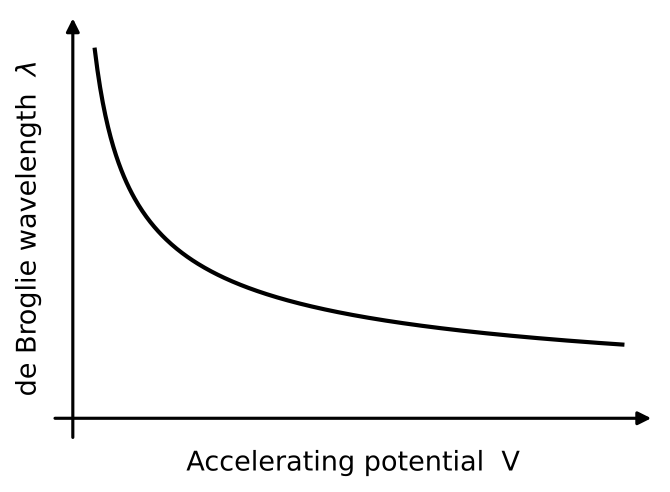
Draw a graph showing the variation of de-Broglie wavelength of a particle of charge q and mass m with the accelerating potential. A proton and a deuteron have the same de-Broglie wavelengths. Explain which has more kinetic energy.
Answer:λ∝1/V; proton has more KE (lighter mass).
Solution
The de-Broglie wavelength is λ=2mqVh∝V1, so the graph of λ versus V is a decreasing curve (see figure). For equal de-Broglie wavelengths, λ=2mKh gives K=2mλ2h2∝m1. Since the deuteron is heavier than the proton (md>mp), for the same λ the proton has the greater kinetic energy.