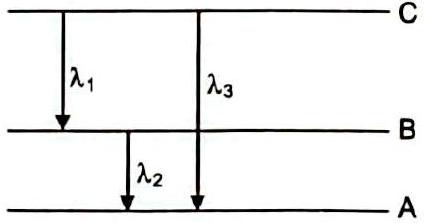
(i) State Bohr's quantization condition for defining stationary orbits. How does the de-Broglie hypothesis explain the stationary orbits? (ii) Find the relation between the three wavelengths λ1, λ2 and λ3 from the energy level diagram shown.
Answer:mvr=nh/2π (2πr=nλ); 1/λ3=1/λ1+1/λ2.
Solution
(i) Bohr's condition: the electron can occupy only those orbits in which its angular momentum is an integral multiple of 2πh, i.e. mvr=2πnh. Using de-Broglie's hypothesis (λ=h/mv), this is equivalent to 2πr=nλ: a stationary orbit is one whose circumference contains a whole number of de-Broglie wavelengths, forming a standing wave that does not radiate. (ii) From the level diagram (levels A, B, C with C>B>A): EC−EB=λ1hc, EB−EA=λ2hc, EC−EA=λ3hc. Adding the first two and equating to the third: