CBSE Class 12 · 2009 · Modern PhysicsVery Short Answer

WhatsApp Email
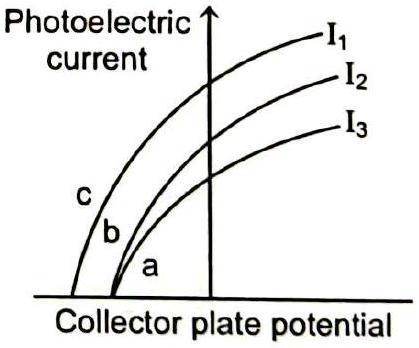
The figure shows a plot of three curves a, b, c showing the variation of photocurrent vs collector plate potential for three different intensities , and having frequencies , and respectively incident on a photosensitive surface. Point out the two curves for which the incident radiations have the same frequency but different intensities.

Answer: Curves and (same stopping potential).

Solution

The stopping potential (the negative potential at which the current becomes zero) depends only on the frequency of the incident light.
Curves that meet the potential axis at the same stopping potential therefore have the same frequency; different saturation currents then mean different intensities.
In the figure curves and share the same stopping potential but have different saturation currents.
CBSE Class 12 Board · 2009 · Subjective

More board questions on Modern Physics

  1. The potential energy between two nucleons inside a nucleus is minimum at a distance of about
    CBSE 2024View solution →
  2. The variation of the stopping potential with the frequency of the incident radiation for four metals A, B, C and D is shown in the figure. For the same frequency of incident radiation producing photo-electrons in all metals, the kinetic energy of photo-electrons will …
    CBSE 2024View solution →
  3. The energy of an electron in the ground state of a hydrogen atom is eV. The kinetic and potential energy of the electron in the first excited state will be
    CBSE 2024View solution →
  4. Assertion (A): An alpha particle is moving towards a gold nucleus. The impact parameter is maximum for the scattering angle of .
    Reason (R): The impact parameter in an alpha particle scattering experiment does not depend upon the atomic number of the target nucleus.
    CBSE 2024View solution →
  5. Calculate the energy released / absorbed (in MeV) in the nuclear reaction . Given , , …
    CBSE 2024View solution →
  6. A proton of energy 1.6 MeV approaches a gold nucleus . Find the distance of its closest approach.
    CBSE 2024View solution →