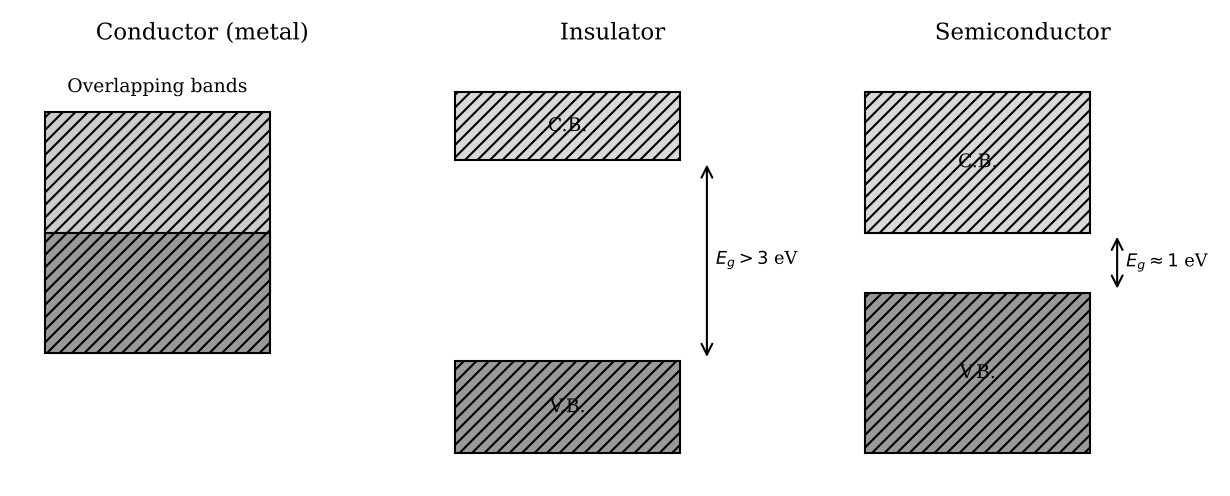
(a) Distinguish between metals, insulators and semiconductors on the basis of their energy bands. (b) Why are photodiodes used preferably in reverse bias condition? A photodiode is fabricated from a semiconductor with band gap of 2.8eV. Can it detect a wavelength of 6000nm? Justify.
Solution
(a) Metals have overlapping conduction and valence bands (or a partly filled conduction band), so there are always free carriers. Insulators have a large forbidden gap (Eg>3eV) so electrons cannot reach the conduction band. Semiconductors have a small gap (Eg≈1eV) so some carriers are thermally excited at room temperature. (b) Photodiodes are used in reverse bias because, on illumination, the fractional change in the small reverse (minority-carrier) current is large and easily measured. For detection the photon energy must satisfy hν≥Eg, i.e. λ≤hc/Eg=1240/2.8≈443nm. The energy of a 6000nm photon is
E=6000nm1240eVnm≈0.21eV.
Since 0.21eV<2.8eV=Eg, the photon cannot excite a carrier across the gap. No; 0.21eV<Eg=2.8eV.