CBSE Class 12 · 2010 · SemiconductorsShort Answer

WhatsApp Email
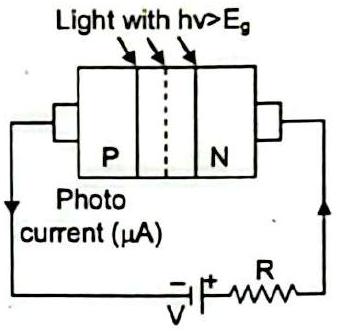
Draw the circuit diagram of an illuminated photodiode in reverse bias. How is a photodiode used to measure light intensity?

Solution

Connect the photodiode in reverse bias (p-side to −, n-side to +) with a transparent window exposing the junction.
Incident photons of energy create electron-hole pairs in the depletion region; these are swept across the junction giving a reverse photocurrent.
Since the number of pairs produced per second is proportional to the light intensity, the photocurrent is proportional to the intensity and can be used to measure it.

CBSE Class 12 Board · 2010 · Subjective

More board questions on Semiconductors

  1. A pure Si crystal having atoms is doped with 1 ppm concentration of antimony. If the concentration of holes in the doped crystal is found to be , the concentration (in ) of intrinsic charge carr …
    CBSE 2024View solution →
  2. (a) Explain the characteristics of a p-n junction diode that makes it suitable for its use as a rectifier.
    (b) With the help of a circuit diagram, explain the working of a full wave rectifier.
    CBSE 2024View solution →
  3. Explain the following, giving reasons.
    (a) A doped semiconductor is electrically neutral.
    (b) In a p-n junction under equilibrium, there is no net current.
    (c) In a diode, the reverse current is practically independent of the applied voltage.
    CBSE 2024View solution →
  4. In an extrinsic semiconductor, the number density of holes is . If the number density of intrinsic carriers is , the number density of electrons in it is
    CBSE 2023View solution →
  5. Pieces of copper and of silicon are initially at room temperature. Both are heated to temperature T. The conductivity of
    CBSE 2023View solution →
  6. The formation of depletion region in a p-n junction diode is due to
    CBSE 2023View solution →