CBSE Class 12 · 2008 · All India · SemiconductorsShort Answer

WhatsApp Email
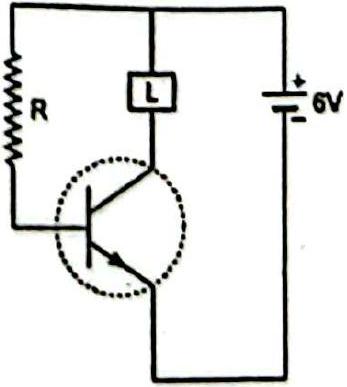
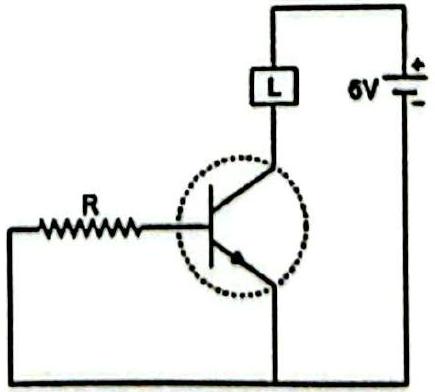
In only one of the two circuits shown, the lamp L glows. State, with reason, in which circuit the lamp lights up.

Solution

For transistor action the emitter-base junction must be forward biased and the collector-base junction reverse biased.
In circuit (i) the emitter-base junction is not forward biased, so negligible current flows and the lamp L does not light.
In circuit (ii) the emitter-base junction is forward biased, so a collector current flows through L and the lamp lights up.

CBSE Class 12 Board · 2008 · All India · Subjective
More board questions on Semiconductors

  1. A pure Si crystal having atoms is doped with 1 ppm concentration of antimony. If the concentration of holes in the doped crystal is found to be , the concentration (in ) of intrinsic charge carr …
    CBSE 2024View solution →
  2. (a) Explain the characteristics of a p-n junction diode that makes it suitable for its use as a rectifier.
    (b) With the help of a circuit diagram, explain the working of a full wave rectifier.
    CBSE 2024View solution →
  3. Explain the following, giving reasons.
    (a) A doped semiconductor is electrically neutral.
    (b) In a p-n junction under equilibrium, there is no net current.
    (c) In a diode, the reverse current is practically independent of the applied voltage.
    CBSE 2024View solution →
  4. In an extrinsic semiconductor, the number density of holes is . If the number density of intrinsic carriers is , the number density of electrons in it is
    CBSE 2023View solution →
  5. Pieces of copper and of silicon are initially at room temperature. Both are heated to temperature T. The conductivity of
    CBSE 2023View solution →
  6. The formation of depletion region in a p-n junction diode is due to
    CBSE 2023View solution →