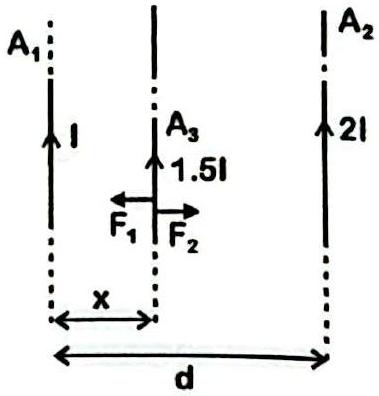
Two infinitely long straight wires A1 and A2 carrying currents I and 2I flowing in the same direction are kept a distance 'd' apart. Where should a third straight wire A3 carrying current 1.5I be placed between A1 and A2 so that it experiences no net force due to A1 and A2? Does the net force acting on A3 depend on the current flowing through it?
Solution
Let A3 be at distance x from A1, so it is (d−x) from A2. The force per unit length from a long wire is 2πrμ0IaIb. For zero net force the two forces (which are opposite, since A1,A2 are on opposite sides) must be equal in magnitude:
2πxμ0(1.5I)I=2π(d−x)μ0(1.5I)(2I).
x1=d−x2⇒d−x=2x⇒x=3d.
So A3 is placed at 3d from A1 (the weaker-current wire). The net force magnitude is F=I3(B1+B2) per unit length, which is proportional to I3; the null position itself is independent of I3, but away from it the force does depend on the current in A3.