(a) Explain, giving reasons, the basic difference in converting a galvanometer into (i) a voltmeter and (ii) an ammeter. (b) Two long straight parallel conductors carrying steady currents I1 and I2 are separated by a distance d. Explain briefly, with a suitable diagram, how the magnetic field due to one conductor acts on the other. Hence deduce the expression for the force between the two conductors and mention its nature.
Solution
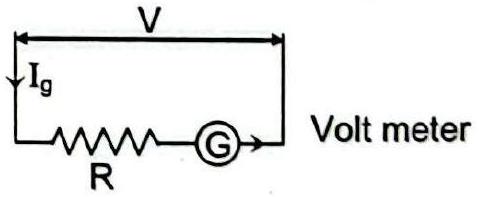
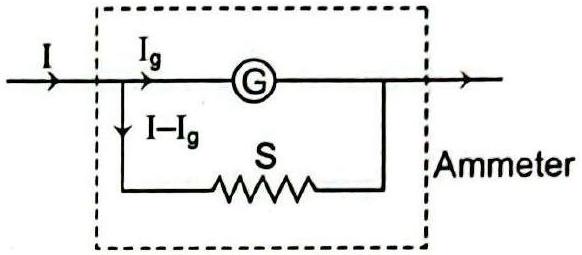
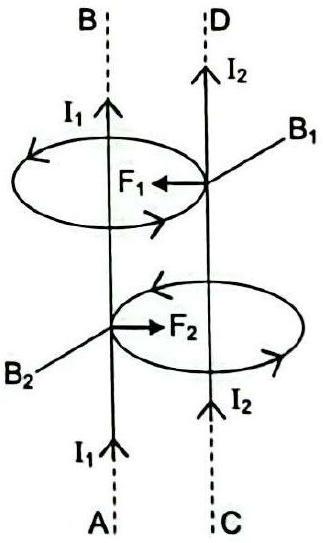
(a) A \textbf{voltmeter} must draw negligible current, so a \textbf{high resistance} is added in series (R=IgV−G). An \textbf{ammeter} must pass large current with little disturbance, so a \textbf{low shunt} is added in parallel (S=I−IgIgG). (b) Conductor 1's field at conductor 2 is B1=2πdμ0I1, giving force per unit length
ℓF=B1I2=2πdμ0I1I2,
attractive when the currents are in the same direction and repulsive when opposite.
CBSE Class 12 Board · 2012 · All India · Subjective