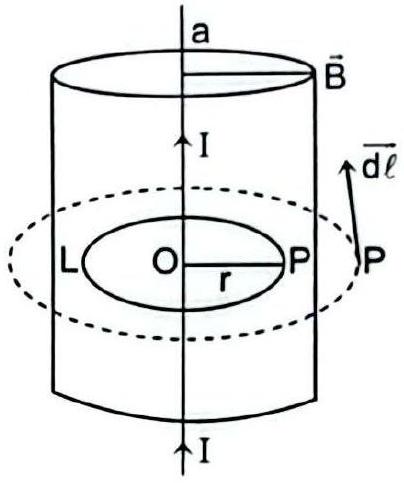
A long straight wire of circular cross-section of radius a carries a steady current I distributed uniformly across the cross-section. Apply Ampere's circuital law to calculate the magnetic field at a point r for (i) r<a and (ii) r>a.
Answer: (i) B=2πa2μ0Ir for r<a; (ii) B=2πrμ0I for r>a.
Solution
Take a circular amperian loop of radius r coaxial with the wire; by symmetry B is tangential and uniform, so ∮B⋅dℓ=B(2πr). (i) For r<a the enclosed current is the fraction I′=πa2Iπr2=a2Ir2, so
B(2πr)=μ0a2Ir2⇒B=2πa2μ0Ir(B∝r).
(ii) For r>a the whole current I is enclosed, so
B(2πr)=μ0I⇒B=2πrμ0I(B∝r1).
The field rises linearly inside and falls as 1/r outside, matching at the surface r=a.