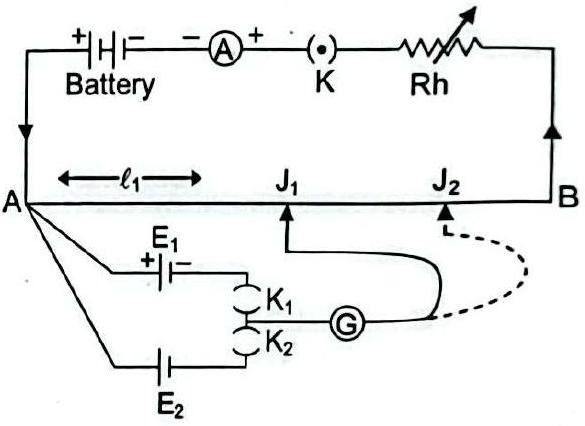
Define the term 'resistivity' and write its SI unit. Derive the expression for the resistivity of a conductor in terms of the number density of free electrons and the relaxation time. \\ \textbf{OR} \\ State the principle of a potentiometer. Draw a circuit to compare the EMFs of two primary cells and write the formula used. How can the sensitivity of a potentiometer be increased?
Solution
\textbf{Resistivity} ρ is defined by R=ρAℓ — numerically the resistance of a unit cube; SI unit Ωm. Derivation: I=neAvd with vd=meEτ and E=ℓV gives I=mne2Aτ⋅ℓV. By Ohm's law R=IV=ne2τAmℓ; comparing with R=ρAℓ,
ρ=ne2τm.
\textbf{OR:} the fall of potential along a uniform current-carrying wire is proportional to its length (V=kℓ). Balancing each cell in turn gives E1=kℓ1, E2=kℓ2, so E2E1=ℓ2ℓ1. Sensitivity rises when the potential gradient k is made small (use a longer wire or a smaller driving current).