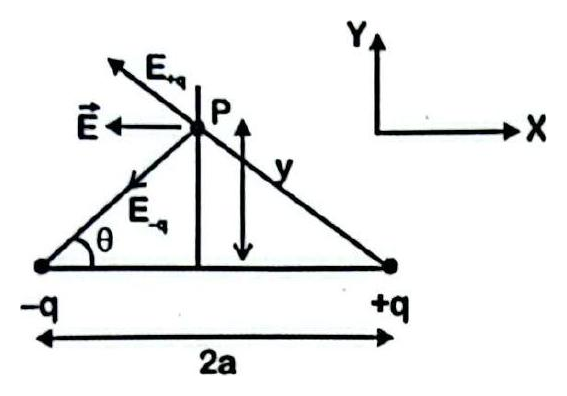
(a) Derive an expression for the electric field at any point on the equatorial line of an electric dipole. (b) Two identical point charges, q each, are kept 2 m apart in air. A third point charge Q of unknown magnitude and sign is placed on the line joining the charges such that the system remains in equilibrium. Find the position and nature of Q.
Solution
(a) Let P be an equatorial point at distance r; each charge is at r2+a2:
E+=E−=4πε01r2+a2q
Perpendicular components cancel; axial components add, with cosθ=r2+a2a:
E=4πε01(r2+a2)3/2p
anti-parallel to p; for r≫a, E=4πε01r3p. (b) By symmetry Q sits at the mid-point, 1 m from each q. For an outer charge to be in equilibrium, attraction by Q equals repulsion by the other q: