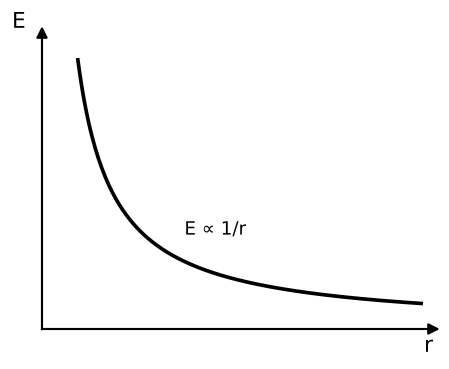
(a) Use Gauss's law to derive the expression for the electric field E due to a straight uniformly charged infinite line of charge density λC m−1. (b) Draw a graph to show the variation of E with perpendicular distance r from the line of charge. (c) Find the work done in bringing a charge q from perpendicular distance r1 to r2 (r2>r1).
Solution
(a) With a coaxial Gaussian cylinder (radius r, length ℓ):
E(2πrℓ)=ε0λℓ⇒E=2πε0rλ
(b) Since E∝r1, the graph of E against r is a rectangular hyperbola. (c) Work done from r1 to r2: