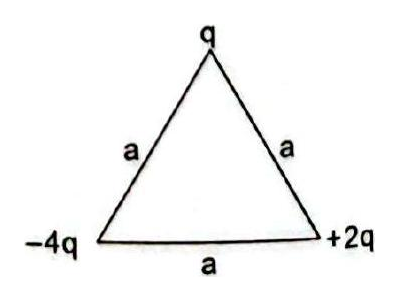
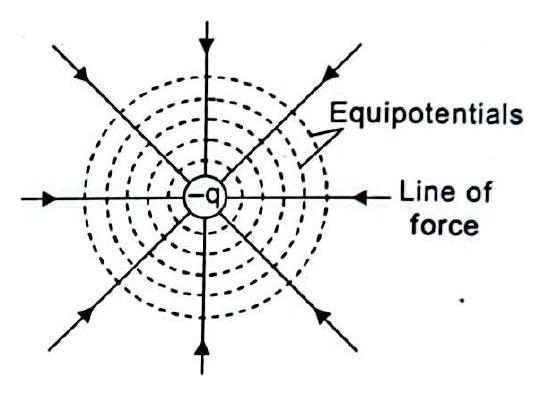
(a) Explain why, for any charge configuration, the equipotential surface through a point is normal to the electric field at that point. Draw a sketch of equipotential surfaces due to a single charge (−q), depicting the electric field lines due to the charge. (b) Obtain an expression for the work done to dissociate the system of three charges placed at the vertices of an equilateral triangle of side a as shown (charges −4q, +2q and q).
Solution
(a) On an equipotential surface the potential is constant, so no work is done moving a charge along it:
W=qΔV=0
Hence the field has no component along the surface — E is everywhere normal to the equipotential surface. For an isolated charge −q, the equipotentials are concentric spheres and the field lines point radially inward. (b) Potential energy of the system: