CBSE Class 12 · 2015 · ElectrostaticsLong Answer

WhatsApp Email
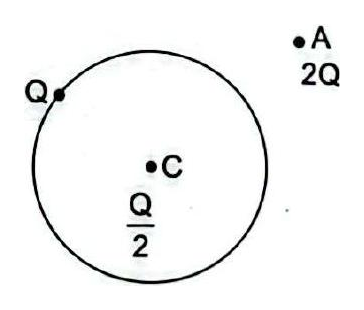
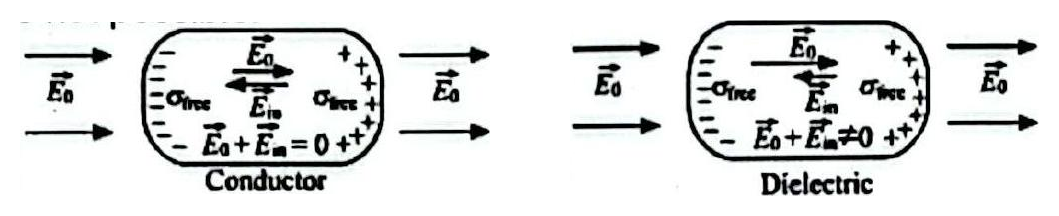
(a) Explain, using suitable diagrams, the difference in the behaviour of a (i) conductor and (ii) dielectric in the presence of an external electric field. Define the terms polarization of a dielectric and write its relation with susceptibility. (b) A thin metallic spherical shell of radius carries a charge on its surface. A point charge is placed at its centre C and another charge is placed outside the shell at a distance from the centre as shown in the figure. Find (i) the force on the charge at the centre of the shell and at the point A, (ii) the electric flux through the shell.

Solution

(a) In a conductor, free charges move until the induced field exactly cancels the external field, so the net field inside is zero. In a dielectric there are no free charges; the molecules only polarise, setting up an opposing field that reduces, but does not cancel, the external field. Polarization is the induced dipole moment per unit volume; for a linear dielectric , where is the electric susceptibility. (b)(i) The field inside the shell (due to the shell's own charge) is zero, so the force on the central charge is zero. For the external point A at distance , the shell plus the central charge behave as a charge at the centre, so . (ii) Flux through the shell depends only on the charge enclosed by it, which is the central charge : .

CBSE Class 12 Board · 2015 · Subjective

More board questions on Electrostatics

  1. Assertion (A): Equal amounts of positive and negative charges are distributed uniformly on two halves of a thin circular ring as shown in the figure. The resultant electric field at the centre O of the ring is along OC. Reason (R): It is so because the net potential at O is not z …
    CBSE 2024View solution →
  2. Four point charges of , , and are placed at the corners A, B, C and D respectively of a square of side 30 cm. Find the net force acting on a charge of placed at the centre of the square.
    CBSE 2024View solution →
  3. Three point charges each are kept at the vertices of an equilateral triangle of side 10 cm. Find the net electric field at the centroid of the triangle.
    CBSE 2024View solution →
  4. (a)(i) Draw equipotential surfaces for an electric dipole. (ii) Two point charges and are located at and respectively in an external electric field . Obtain an expression for the potential energy of the system. (iii) The dipole moment …
    CBSE 2024View solution →
  5. (b)(i) A thin spherical shell of radius has a uniform surface charge density . Using Gauss's law, deduce an expression for the electric field (i) outside and (ii) inside the shell. (ii) Two long straight thin wires AB and CD have linear charge densities …
    CBSE 2024View solution →
  6. The magnitude of the electric field due to a point charge object at a distance of 4.0 m is 9 N/C. From the same charged object the electric field of magnitude 16 N/C will be at a distance of
    CBSE 2023View solution →