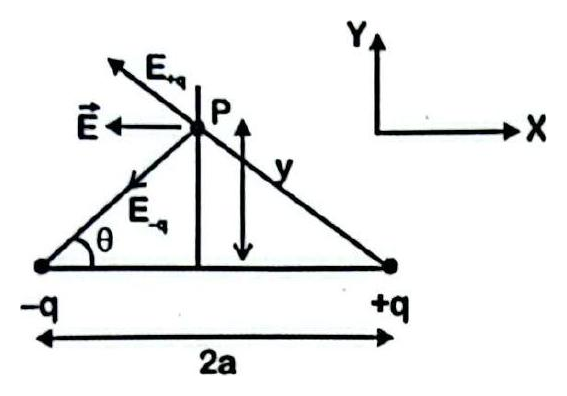
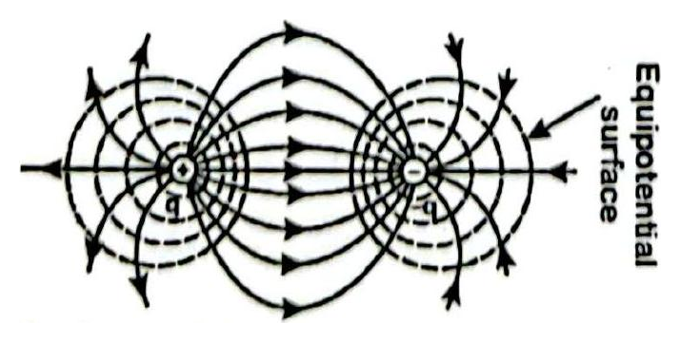
(a) Define electric dipole moment. Is it a scalar or a vector? Derive the expression for the electric field of a dipole at a point on the equatorial plane of the dipole. (b) Draw the equipotential surfaces due to an electric dipole. Locate the points where the potential due to the dipole is zero.
Solution
(a) Dipole moment p=q(2a) is a vector directed from −q to +q. Let P be an equatorial point at distance r from the centre O; each charge is at r2+a2:
E+=E−=4πε01r2+a2q
The perpendicular components cancel; the axial components add, with cosθ=r2+a2a:
E=2E+cosθ=4πε01(r2+a2)3/2p
directed anti-parallel to p. For r≫a:
E=4πε01r3p
(b) The equipotentials are symmetric about the axis; the potential is zero everywhere on the equatorial plane, since each point there is equidistant from +q and −q.