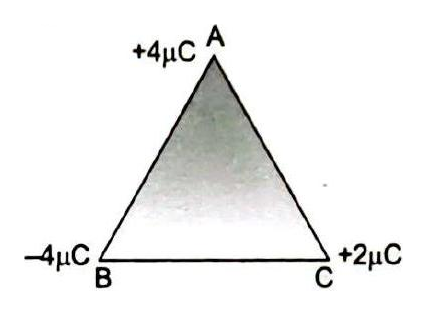
(b)(i) Consider two identical point charges located at points (0,0) and (a,0). (1) Is there a point on the line joining them at which the electric field is zero? (2) Is there a point on the line joining them at which the electric potential is zero? Justify. (ii) State the significance of the negative value of electrostatic potential energy of a system of charges. Three charges are placed at the corners of an equilateral triangle ABC of side 2.0 m as shown in the figure (+4μC at A, −4μC at B, +2μC at C). Calculate the electric potential energy of the system of three charges.
Solution
(i)(1) For two identical (equal, like) charges the fields are equal and opposite at the mid-point.
E=0 at (2a,0)
(2) The potential of each like charge is positive everywhere, so their sum can never be zero on the line joining them — there is no such point. (ii) A negative potential energy means the system is bound: positive work equal to ∣U∣ must be done to separate the charges to infinity.