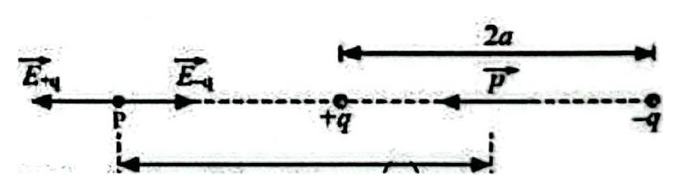
Deduce an expression for the electric potential due to an electric dipole at any point on its axis. Mention one contrasting feature of electric potential of a dipole at a point as compared to that due to a single charge.
Solution
Let P be a point on the axis at distance r from the centre O. Then P is at (r−a) from +q and (r+a) from −q. Potential is a scalar, so the net potential is the algebraic sum:
V=4πε01(r−a)q+4πε01(r+a)(−q)
V=4πε0q[r−a1−r+a1]
Taking the common denominator,
V=4πε0qr2−a22a=4πε01r2−a2p,p=q(2a)
For r≫a, r2−a2≈r2:
V=4πε01r2p
Contrast: the dipole potential falls as 1/r2 (faster than the 1/r of a single charge) and depends on direction.